
Writing Isn’t As Important As We Think – NY Times 9-29-2026
Re:
“I’m a College Professor. Writing Isn’t as Important as We Think.,” By Joe Cruz, op-ed, The New York Times, Sept. 29, 2026
Word document posted above
This an example of a piece written by a writer who is eager to show he has something new to offer. On a subject — writing, rhetoric — about which the best has already been said.
*****************************************************
I sent the article to my friend (going back to our high school days in New England) Tom Linehan.
With the following comments:
I am not impressed.
And just having read this op-ed, I find I disagree — completely, or almost so (at the least).
*****************************************************
He commented as follows.
Roger, Could not agree more with your view. This strikes me as investing an old complaint most students have had at one point or another with some recent experiences and factoids to seem a fresh insight.
Think it is the reverse: writing is important because it requires organizing your argument, supplying supporting data, and showing how you arrive at a specific conclusion or interpretation. You amend the language to make your meaning clearer, to eliminate unnecessary detail, and to make your arguments as sharp and specific as possible to assert your conclusion.
Very few students could perform these functions as well using only thinking [italics added], and a tiny minority could debate the topic to carry an important point, as opposed to speaking articulately to counter the objections raised by others. Sprightly counterpoint so useful in debate is not what good writing is intended to inculcate.
*****************************************************
“Very few students could perform these functions as well using only thinking,” he writes.
This gets at the core of my own experience as a high school, college student and professional writer.
Writing involves mental processes that were also involved in courses I took in French, Latin, and mathematics, that are applicable to writing (composition).
The ability to organize information and develop and articulate a coherent and cogent train of thought. An argument (used in the broad sense).
It also involves — requires — the gift of language. Expression. Which is both inherent and/or acquired and which is developed through constant practice and application.
Such as a craftsman learning a trade.
Such as (the gift of expression, that is) writers like Melville and Hawthorne had. Theodore Dreiser. Thomas Wolfe. Henry Miller.
These writers were not necessarily outstanding thinkers, or intellectuals per se.
They had the sort of gift that great conversationalists have.
They WROTE.
The way a composer or songwriter composes.
The labor of words, as the literary scholar Christopher P. Wilson put it, is very much a mental activity. And, a form of mental labor.
It can’t be mastered through theorems, axioms, mental games, or classroom discussions.
— posted by Roger W. Smith
October 2026
that captures the essence of a breaking news story.
* * *
Just when you think Eric Schmitt couldn’t possibly embarrass himself and his constituents any more than he already has, he goes in for a rhetorical layup, gratuitously throws an elbow, spectacularly misses the shot and then stomps around the court indignantly when the ref calls foul.
“Eric Schmitt airballs with ‘dirtbag’ attack,” By the Post-Dispatch Editorial Board , St. Louis Post-Dispatch. September 30, 2026
*****************************************************
Eric Schmitt is the junior United States senator from Missouri. On September 29, 2026, he received national attention for his erroneous line of questioning during a Senate Judiciary Committee hearing about the Smith special counsel investigation into Donald Trump’s attempts to overturn the 2020 presidential election.
Schmitt falsely accused the witness, former special counsel Jack Smith, of perjury for denying that he had attended an Atlanta Hawks–Golden State Warriors basketball game in Atlanta, Georgia on February 3, 2024.
Smith did not attend the Hawks–Warriors game, rather the Iowa Hawkeyes–Maryland Terrapins women’s basketball game at the University of Maryland, College Park on that date.
— posted by Roger W. Smith
October 1, 2026
PIEDMONT PEOPLE
Bert & Eleanor Harris
By Pete Smith
This essay (Word document above) was published by my older brother Pete Smith in the August 2026 issue of Warrenton Lifestyle, a magazine published in Warrenton, Fauquier County, VA.
It is notable that my brother — who majored in English — and I had the same outstanding English teacher in high school, Robert W. Tighe.
Mr. Tighe’s influence shows.
I have highlighted in boldface some key passages in the essay.
* * *
Just north of Warrenton, on 900 rolling acres under permanent conservation easement, two scientists have spent the better part of a decade quietly doing something remarkable — turning a small, scrappy nonprofit into one of the region’s most vital centers for ecological research, environmental education, and land stewardship. Bert and Eleanor Harris, Co-Directors of The Clifton Institute, deserve far more recognition than they typically seek.
Their credentials alone are impressive. After earning his B.S. in Ecology and Biodiversity at Sewanee: The University of the South, Bert completed a Ph.D. in Ecology and Evolutionary Biology at the University of Adelaide, Australia, followed by a postdoctoral fellowship at Princeton University. Eleanor’s path was equally distinguished but charmingly indirect: she earned her B.A. in Mathematics at the University of Chicago, then — rediscovering a childhood love of animals — completed a Ph.D. in Quantitative and Computational Biology at Princeton, followed by a postdoctoral fellowship at the University of Maryland.
What they’ve built together at Clifton is a place that operates at the intersection of science, education, and conservation in ways that are rare for an organization of its size. Bert directs a program of ecological research aimed at providing actionable recommendations to landowners, working with his team to restore native plant and animal communities on the Institute’s 900-acre property — translating findings from peer-reviewed science into practical guidance for farmers and landowners in the Piedmont community. Eleanor oversees all of the organization’s activities as Co-Director, with a particular focus on education and development.
The numbers tell part of the Institute’s story. Staff have documented 2,600 different species on the property, and the Institute holds the largest dataset in the world on kestrel movements — a distinction remarkable for an organization rooted in Northern Virginia. Last year, more than 3,000 students came through Clifton’s education programs, experiencing firsthand what it means to walk through native meadows, observe raptors in flight, or press a wildflower seed into restored soil.
But perhaps what distinguishes Bert and Eleanor most is their philosophy. Before coming to Clifton, Bert observed that too much conservation biology is published in papers that nobody reads — and they’ve spent their tenure here correcting that. Programs range from field trips and summer camps to natural history lectures, nature journaling workshops, and an annual Native Plant Sale. The research they commission is carefully chosen: targeted projects that benefit how landowners can manage their land, not abstractions for distant audiences.
Fauquier County and the broader Northern Virginia Piedmont are richer — ecologically and communally — for the work Bert and Eleanor – and now their daughter Thea – have poured into this place. In a region under relentless development pressure, they tend to 900 acres of living, breathing evidence that conservation and community can grow together.
* * *
*****************************************************
In my post
Learning How to Write
I wrote:
Mr. Tighe said that there were three elements to good writing: unity, coherence, and emphasis.
The second element, coherence, Mr. Tighe explained that this was sort of like glue.
You had to tie all your paragraphs and sentences together by using transitional words that guide the reader: on the other hand, in contrast, furthermore, however, and so on. I got the idea quickly and was soon larding my essays with such words. It became a little heavy handed.
When I became a more experienced writer, I learned that you can achieve this in more subtle ways.
*****************************************************
My brother Pete obviously learned this.
Subject to strict word limits (space limitation), he has written an interesting essay that flows naturally.
With smooth, effective transitions.
That is not a boilerplate summary or report.
The article holds the reader’s interest — because the author, Smith, makes it a point to tell us why he is mentioning this or that.
You would be surprised how many writers never do this.
It is done in the transitions.
For example:
The numbers tell part of the Institute’s story.
But perhaps what distinguishes Bert and Eleanor most …
*****************************************************
I am attaching here an article I wrote for New York Newsday, in which. I achieved the same things as my brother did. I made it interesting by showing readers why the doctor and his career were of particular interest.
‘Borough Park Physician Retires After 60 Years’
— posted by Roger W. Smith
August 2026
oðþæt him æghwylc þara ymbsittendra
ofer hronrade hyran scolde
In the end each clan on the outlying coasts
beyond the whale-road had to yield to him
,– Beowulf, Prologue
A brilliant metaphor.
*****************************************************
connect to listen to prologue
https://drive.google.com/file/d/1GcAULmWJskG0QQVCvs2eBa16iaY54Krg/view
— posted by Roger W. Smith
June 2026
The invention of letters was followed more than two millenia later by the invention of movable type, a revolution without which the Renaissance and the Reformation would not even have been possible. But with the increase in the availability of the written word, there have been losses once again. For every work of Shakespeare put between covers, there are twenty cheap romance novels. For every book designed to teach an intelligent public, there are fifty newspapers distorting events. And for every learned tome, there are AN HUNDRED volumes of pornography.
“The Decline of the Book & the Fall of Western Civilization,” By Martin Cothran, The Imaginative Conservative, March 8, 2026
*****************************************************
It should be a hundred. An hundred is an archaic form which the author is using, in an affected manner, to show that he is highbrow.
— posted by Roger W. Smith
April 2026
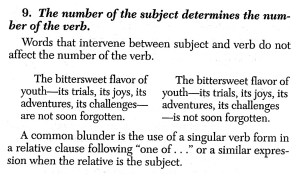
Backing Trump as he tries to rewrite the Constitution by executive fiat is much of the Republican Party and a collection of conservative legal scholars who rushed, in the wake of his decree, to try to give substance to the president’s thin, unpersuasive argument. Against Trump IS the weight of Supreme Court precedent, historical consensus and the plain words of the clause itself. – Jamelle Bouie, “The Birthright Con,” The New York Times, April 1, 2026
It should be: ARE the weight …
the subject of the sentence is comprised of three nouns: weight, conesnsus. and words.
*****************************************************
This should be elementary, but journalists and commentators in the media frequently ignore the rule. Sloppiness is one thing, but they obviously don’t even know it.
— posted by Roger W. Smith
April 2026
Having already lost a lot of money earlier in the season, Handel now realized the folly of his gamble, and announced in London’s Daily Advertiser that he was closing his ambitious season early. He eloquently expressed the profound sorrow this failure* had given him in his announcement: “As I perceived, that joining good Sense and significant Words to Musick was the best Method of recommending this to an English Audience; I have directed my Studies that way, and endeavour’d to show, that the English language, which is so expressive of the sublimest Sentiments, [italics added] is the best adapted … to the full and solemn Kind of Musick. I have the Mortification now to find that my Labours to please are become ineffectual.” (program notes, Carnegie Hall)
*The premiere of his oratorio Hercules, in January 1745.
— posted by Roger W. Smith
March 2026

