Monthly Archives: January 2019

regarding Professor Strunk’s admonition, “Omit Needless Words.” (or, are long, complex sentences bad?)


Should long, complex sentences be considered, a priori, evidence of bad writing? Ask Samuel Johnson. Or practically any other great writer one can think of.

Sometimes the shortest sentences can be extremely powerful: “Jesus wept” (John 11:35).

But, note what Professor Brooks Landon has to say in his lecture ““Grammar and Rhetoric” (lecture 2, “Building Great Sentences: Exploring the Writer’s Craft”; The Great Courses/The Teaching Company).


*****************************************************

… unless the situation demands otherwise, sentences that convey more information are more effective than those that convey less. Sentences that anticipate and answer more questions that a reader might have are better than those that answer fewer questions. Sentences that bring ideas and images into clearer focus by adding more useful details and explanation are generally more effective than those that are less clearly focused and that offer fewer details. In practice, this means that I generally value longer sentences over shorter sentences as long as the length accomplishes some of those important goals I’ve just mentioned.

Many of us have been exposed over the years to the idea that effective writing is simple and direct, a term generally associated with Strunk and White’s legendary guidebook The Elements of Style, or we remember some of the slogans from that book, such as, “Omit needless words.” … [Stunk concluded] with this all important qualifier: “This requires not that the writer make all his sentences short, or that he avoid all detail and treat his subjects only in outline, but that he make every word tell.” … Strunk’s concern is specifically with words and phrases that do not add propositions to the sentence [e.g., “owing to the fact that” instead of “since”].”

… simple does not mean simplistic. Direct does not mean short. And, simple and direct does not mean that we should all write like Ernest Hemingway in a hurry. “Omit needless words” is great advice, but not when it gets reduced to the belief that shorter is always better, or that “needless” means any word without which the sentence can still make sense.

… I like Faulkner, as well as I like Hemingway. And, I’d like to believe that even Professor Will Strunk and certainly E. B. White would not have tried to edit Faulkner out of existence.

… Strunk and White do a great job of reminding us to avoid needless words, but they don’t begin to consider all of the ways in which more words might actually be needed. … in many cases, we need to add words to improve our writing … rather than trying to pare our writing down to some kind of telegraphic minimum.

— posted by Roger W. Smith

   July 2017


*****************************************************

Addendum:

from Wikipedia

https://en.wikipedia.org/wiki/Jesus_wept

Jesus wept (Greek: ἐδάκρυσεν ὁ Ἰησοῦς, edákrysen o Iesoús lit. “Jesus shed tears”) is a phrase famous for being the shortest verse in the King James Version of the Bible, as well as many other versions. It is not the shortest in the original languages. It is found in the Gospel of John, chapter 11, verse 35.

This verse occurs in John’s narrative of the death of Lazarus of Bethany, a follower of Jesus. Lazarus’ sisters – Mary and Martha – sent word to Jesus of their brother’s illness and impending death, but Jesus arrived four days after Lazarus died. Jesus, after talking to the grieving sisters and seeing Lazarus’ friends weeping, was deeply troubled and moved.

show, don’t tell


The following is an exchange of emails between a friend and myself from last night and this morning. (April 14-15, 2016)


*****************************************************

Scott,

I am rereading my own stuff, namely, my “autobiography.”

I think it illustrates an important aspect of writing one is supposed to learn, be taught: SHOW, don’t tell.

Roger


*************************************************************

Roger,

Do you mean, the reader should see it, feel it; you shouldn’t have to try to explain it through words?

Scott


***************************************************************

Scott,

What I mean it is:

One sees awful GENERIC writing all the time.

You get a communiqué from a relative or friend: “Having a great time in Paris … wonderful! … beautiful city … fascinating … we love it.”

Tell me WHAT makes Paris so wonderful in your experience and from your vantage point. Tell me something about:

What you are doing or enjoying. What you had for breakfast. A café you were at. An interesting person you met. A show you saw. A street you liked. Your hotel. What the service and staff are like. Where you have been and what you did there.

As Walt Whitman put it in a letter to a friend (1863): “don’t run away with [the] theme & occupy too much of your letter with it – but tell me mainly about all my dear friends, & every little personal item, & what you all do, & say &c.”

Here’s s what is said on Wikipedia:

https://en.wikipedia.org/wiki/Show,_don’t_tell

Show, don’t tell is a technique often employed in various kinds of texts to enable the reader to experience the story through action, words, thoughts, senses, and feelings rather than through the author’s exposition, summarization, and description. The goal is not to drown the reader in heavy-handed adjectives, but rather to allow readers to interpret significant details in the text. The technique applies equally to nonfiction and all forms of fiction ….

In other words, avoid the generic. Make what you want to convey come alive through details. Then the reader can figure out for himself or herself what it was about.

In writing, I try to work in details that come to mind. I feel that that’s what makes a piece interesting. I rely on memory, intuition, and a mental process of association in doing this.

It’s the particulars that give a piece of writing life. No experience, no person is quite the same as any other. That’s what makes life so interesting. And, most experiences aren’t plain vanilla, white bread stuff. People have funny idiosyncrasies. Funny things happen. Things don’t hew to the norm. There are all sorts of surprises, twists, and turns.

I feel that the little details make for interesting reading, make the piece credible, make it work, make it clear just what the experience was, make the story believable to the reader.

It makes you and what you have to say AUTHENTIC.

In my essay “My Boyhood,” I could have said things like: “I had a happy childhood,” “I had a sad childhood,” “I loved baseball,” ‘I hated school,” “I had nice friends,” “my brother was mean to me,” “I loved music,” “I liked to visit my grandparents,” “my teachers were good,” “my teachers were bad,” and so on; and left it at that.

Instead, I have built my essay around carefully selected and minutely described particulars. It’s left to the reader to decide — make his or her own mental construct — what kind of childhood is being described and what he or she (the reader) might be inclined to think or feel based on the piece.

I do intend for words to be used to convey my experiences and meaning, of course, but not generic (aside from the occasional summary statement or editorial comment).


— posted by Roger W. Smith

    April 2016

an example of how to write descriptive prose


“Six boys came running over the hill half an hour early that afternoon, running hard, their heads down, their forearms working, their breath whistling.”

— John Steinbeck, The Red Pony

One can just imagine how the boys were running: “heads down, … forearms working, … breath whistling.” Have your ever seen it? That’s just how boys in a hurry to get somewhere, exerting themselves, do run.


*****************************************************

“The turkeys, roosting in the tree out of coyotes’ reach, clicked drowsily. The fields glowed with a gray frost-like light and in the dew the tracks of rabbits and of field mice stood out sharply.”

— John Steinbeck, The Red Pony


— posted by Roger W. Smith

   September 20, 2017

Roger W. Smith, “An Early Lesson in Writing”


When I was around 13 and still in junior high school, we had a discussion at the dinner table in our home in Massachusetts one Sunday afternoon that was intellectually stimulating, as was often the case.

My older brother was telling us an anecdote about Mr. Tighe, his English teacher at Canton High School.

A girl student had written a paper for Mr. Tighe in which she used the archaic word yclept, meaning named or called. It was used by Chaucer and Milton.

Mr. Tighe ridiculed her for this. He observed that the simplest and clearest word was always desirable.

Being only 13 and not savvy, I was quite surprised to hear this. I spoke up at the dinner table, and said, “I thought that writers were supposed to use big words.”

“Oh no,” my father, Alan W. Smith — who, besides being a musician, was superbly articulate — said, “you should always use the plainest, simplest word.”

I never forgot this discussion and remark. It was a revelation to me, the start of learning how to write well.

It was a salutary “lesson.”


— Roger W. Smith

   March 2016


*****************************************************

COMMENTS


Ella Rutledge, March 1, 2016

Well, it seems to me there were two lessons being learned in that lesson. The first, as you point out, is the lesson of using plain language–straight out of Strunk & White. The second, is what the user of “yclept” no doubt learned: her teacher ridiculed her, which probably made her feel that she could not write. Why not praise rather than ridicule a thirteen-year-old for emulating Chaucer?


Roger W. Smith, March 1, 2016

Thanks much for your comment, Ella. This incident occurred when I was in junior high school. Two years later, I had the same teacher for English. I had him for two years straight, plus one summer school course.

He was an outstanding teacher, a nice man, a wise one. But he did have a mean streak that showed at times. He could be critical, harsh and sarcastic, and was a tough grader. Nevertheless, I respected him greatly. He taught me so much about writing, critical reading, critical analysis, and critical thinking — but, above all, writing.

You have a point. Knowing this teacher, I bet he was hard on the girl and embarrassed her. No doubt, she was trying to impress him and perhaps get a good grade by using a fancy word.

But I think sometimes as a teacher you have to be caustic to get your point across. Yes, straight out of Strunk and White: “keep it simple stupid.” He was right to make this point and he made it stick. So that I never forgot it.

Roger W. Smith, “Learning How to Write”


During the summer of 1962, between my sophomore and junior years at Canton High School in Canton, Massachusetts, a summer school course was offered taught by my older brother’s English teacher, Robert W. Tighe.

I had had practically no writing instruction during my first two years of high school. I was interested in writing and motivated to become a better writer. So I decided to take the course, although my grades in the first two years in English had been straight A’s and the summer course was not required.

But, prior to taking the course, I did self-instruction. I bought a paperback book, Shefter’s Guide to Better Compositions,  by Harry Shefter, and studied it intently. This, along with the course that followed, was a decisive juncture in my development as a writer.

Shefter stressed the importance of having an effective opening to your composition. He counseled and explained how to write an effective lead paragraph, like a journalist would do. Once you had an effective lead, you would state your thesis and develop and expand upon your ideas from there.

In my first composition for Mr. Tighe’s summer course, I began by describing a recent game that took place on June 18, 1961 at Fenway Park between the Boston Red Sox and the Washington Senators — I saw it on television– in which the Red Sox, in the first game of a doubleheader, scored eight runs with two outs in the bottom of the ninth to win 13-12. They won it on a grand slam home run by catcher Jim Paglioroni.

I ended the opening paragraph of my composition with the words “the ball nestled in the nets.” Mr. Tighe liked this and commented to the class on what a felicitous phrase it was. (There were only three students in the class, including me. The other two boys were taking the class as a requirement, because they had failed English.) I followed by saying something like, “that’s why baseball is my favorite sport.”

I was off to a good start with Mr. Tighe. He said, in his sardonic fashion, rubbing his forehead and pushing back his glasses, “I hate to have to admit it, but you’re good.”

I did an awful lot of writing in the next few weeks, and got very close attention to my papers. I put a lot of effort into them.

My last paper was entitled “The Folly of Frugality.” We had been given the assignment of reading a writer, in my case Vance Packard, and trying to emulate his style. I began the paper with my lead (à la Harry Shefter) describing an incident where my best friend’s mother, when I was in the sixth grade, would not let him go on an outing to a neighboring town the two of us had planned because she thought it might be unsafe. Mr. Tighe asked me whether I had made the story up. I told him that the story was an actual one.

The course was invaluable to me, and I did not at all mind the hard work.

Mr. Tighe had been an inspiring teacher and crucial mentor of my older brother. I had him for English in my junior and senior years. I worked very hard in his class and paid close attention to anything and everything he had to say about writing. I could never figure why he gave me a C+ for the first marking period in my junior year. I think he was trying to take me down a peg, to send me a message. (But, I was not by any measure conceited.) Also, I heard years later that it was his policy to give practically everyone a low grade the first time they had him for a teacher.


**************************************

The Three Basic Elements of Good Writing

Mr. Tighe said that there were three elements to good writing: unity, coherence, and emphasis.

The first, UNITY, means that you must stick to the point, be it in your thesis statement (at the opening of a composition) or in a topic sentence.

One of our first assignments was a standard one for beginning writing students: describe something. I wrote a paper describing my bedroom. The emphasis and details were meant to convey what a snug, cozy place my bedroom was — how I liked to be there reading or studying, for example.

When I had nearly finished, I inserted an additional sentence in which I referred to the room’s “long windowless walls.” Mr. Tighe, in grading the paper, underlined this sentence and gave me a low grade. The sentence had conveyed the impression of a dreary place, at variance with the impression created by the other descriptive details. I had violated the principle of UNITY.

The second element of good writing was COHERENCE. Mr. Tighe explained that this was sort of like glue. You had to tie all your paragraphs and sentences together by using transitional words that guide the reader: on the other hand, in contrast, furthermore, however, and so on. I got the idea quickly and was soon larding my essays with such words. It became a little heavy handed. When I became a more experienced writer, I learned that you can achieve this in more subtle ways. But, I have never forgotten or neglected the importance of coherence.

The third element of good writing, EMPHASIS, is the hardest one to achieve; to perceive the presence or lack thereof in a piece of writing; or to explain. It is akin to what a composer strives to achieve in music. A myriad of thoughts, observations, or details in a piece of writing without the proper emphasis can leave the reader disoriented and confused.

Emphasis is achieved by placing weight or stress on certain key points or sections in the essay and on the conclusion. The skillful writer can achieve this sometimes without being obvious. A key point might be made to emerge where one wouldn’t expect it.


Ground Rules

Mr. Tighe taught us to make an OUTLINE before writing. As I grew older and became a more experienced writer, I found that I didn’t have to do this anymore. But, it helped me a lot in school. Even when I had an essay exam, I would jot down a quick outline before starting to draft an answer. I did this on college essay exams, and it helped me get good grades even when I was not that well prepared.

Once I wrote a paper for Mr. Tighe in which I began by making an outline, as usual. Then, at the last minute before beginning to write, I decided to use the outline, but in a totally different order. Mr. Tighe gave me a poor grade and commented that there was a major problem with organization.

I learned a lot about GRAMMAR and STYLE from Mr. Tighe — what you might “Strunk and White precepts” — including precepts about writing that stuck in my mind. For example, when to strike out words. He told us to avoid cumbersome phrases like “the fact that.”

He was strict in grading and it was said he would lower a grade due to a couple of spelling errors, but I didn’t see him do this.

My older brother got at least one A+ from Mr. Tighe on a paper. It was said to be very hard to do. I recall how proud he and my parents were on that occasion. Late in my senior year, I finally got an A+ from Mr. Tighe for a paper on the Romantic poets. (I criticized them. Mr. Tighe did not particularly like the Romantic poets.)


Writing on Demand

In my senior year, we had Mr. Tighe for first period. Often, he would have us start off by writing. It was very difficult to do that — especially, it seemed, at that hour.

He would usually start off by quoting from some piece of writing, an excerpt from The New Yorker or the Atlantic Monthly, for example. Then he would say, with what seemed to be fiendish glee, “say something clever and witty about that.”

The next day, he would have prepared for the class a rexograph sheet containing excerpts — which he had typed up from our handwritten work — from four of the pieces submitted on the previous day. Then he and we the class would discuss and critique the writing samples. It was invaluable instruction in writing — trained me to critique my own work.

I learned to write on demand, which served me very well in college on essay exams (as noted above) and in writing last minute papers, which — due to a severe case of procrastination which I suffered from — I usually had to resort to.


Senior Research Paper

In our senior English class, the term paper at the end of the year was a big deal. Mr. Tighe taught us how to do research and keep track of our sources using index cards. My paper was on J. D. Salinger. I did research in the Boston Public Library. But, being a procrastinator of the worst sort (as noted above), I had to stay up all night the night before the paper was due and barely got it written and typed. I wrote the paper in one draft on my older brother’s typewriter without revision.

I recall that I got a B+. The title of my paper was “Salinger and Utilitarianism.”

From the research paper assignment, one learned how to write a college paper with footnotes. It was the first time I had ever done research, and I enjoyed it. The only Salinger book I read for the assignment was The Catcher in the Rye. Salinger’s Franny and Zoey had been published by then, but I did not read it for purposes of the assignment. (I did read it later and didn’t particularly like or understand it.) I included some criticism on Salinger, which I had read as part of my research, in the paper. I really enjoyed doing research in the Boston Public Library, reading early published fiction by Salinger that most people didn’t know of.


— Roger W. Smith

    December 2015

My English Teacher, Robert W. Tighe


bob-tighe.jpg

Robert W. Tighe in his classroom at Canton High School, Canton, MA in 1960’s

The following is a message of mine posted on Facebook in response to a daughter of my former English teacher Robert W. Tighe.


****************************************************************

In your Facebook post of March 23, 2016, you said, regarding your father: “[his] chosen occupation aligned with his passions, in his case for learning, and sharing his love of learning with others, as well as for language and the role language plays in shaping our understanding of the human experience throughout history and the role it plays in the present as a tool for influencing the thoughts and actions of others.”

Very true, I believe.

From my experience of your father as a teacher, I would say that some things that drove him were:

a love of books, reading, and language;

hatred (if one can use such a strong term) of pomposity and obfuscation in writing and in written and oral expression in general; an abhorrence of cant.

It seemed that this would cause him at times to be impatient and to be a harsh critic.

He was no phony or fake and he didn’t like it when others “put on airs,” so to speak, when writing, declaiming, or participating in a conversation or class discussion; when someone would try to conceal their lack of knowledge, or grasp and penetration of issues, behind a “smokescreen” of bad writing.

He had no use for mawkish, flowery, or overblown language when used to impress the reader or show off.

He was constantly inveighing against excess verbiage and wasted words. His summum bonum was clarity.

I had a close friend from another town in New England. His father was chairman of the English department in the local high school. Once, when I was visiting, my friend took me upstairs and showed me some of his father’s students’ papers. There was an A paper by a star student, a girl. My friend’s father had written comments praising it highly. I read some of the paper and, being a student of Mr. Tighe, immediately realized that it was a God awful paper. It was insipid, mushy writing of the kind your father would have detested.


*****************************************************


A few additional comments.

Your father loved Samuel Johnson. I was told by someone that he had read Bowell’s Life of Johnson something like nine times. One can see why this affinity existed. Samuel Johnson hated cant and hypocrisy, and would skewer with verbal repartee — with his (Johnson’s) legendary wit and sarcasm — anyone who engaged in it.

Your father taught me to read poetry. Sort of. Which is to say that I never really had an ear for poetry or much of an ability to understated it. But, your father would have us reading John Donne, William Blake, or T. S. Eliot and understanding it, getting to the heart of the poem, and, once I could manage to do this, loving the poetry for its ingenuity and beauty.


— Roger W. Smith

    March 25, 2016

pleonasm


Pleonasm is defined as the use of more words than are necessary to convey meaning, either as a fault of style or for emphasis. For example: see with one’s eyes.

From which have, an as example, pleonastic word pairs.


*****************************************************

“[John] Tillotson, who had a great reputation in his day for simplicity and plainness of diction, had an extraordinary bent towards tautology. The following extract, chosen at random from his sermons, is fairly representative:”

Now Religion doth contribute to the peace and quiet of our ways these two ways. First, by allaying those passions which are apt to ruffle and discompose our spirits. Malice and hatred, wrath and revenge are very fretting and vexatious and apt to make our minds sore and uneasy, but he that can moderate these affections will find a strange ease and pleasure in his own spirit. Secondly, by freeing us from the anxieties of guilt, and the fears of divine wrath and displeasure; than which nothing is more stinging and tormenting and renders this life of man more miserable and unquiet. And what a spring of peace and joy must it needs be to apprehend upon good grounds that God is reconcil’d to us and become our friend; that all our sins are perfectly forgiven and shall never more be remembered against us! (John Tillotson, Works, 6th ed., London, 1710, pg. 52)

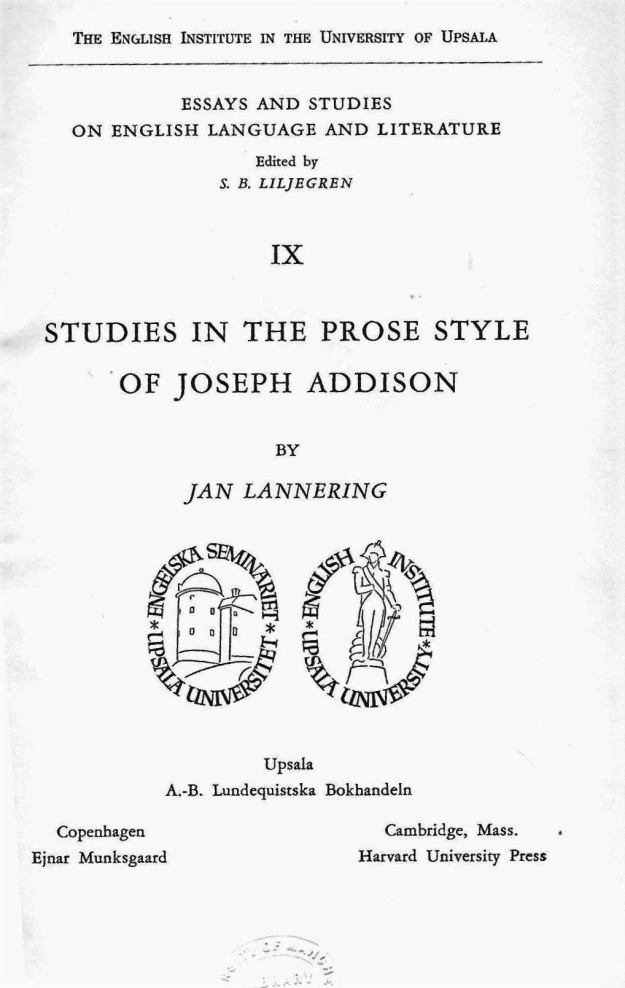
Studies in the Prose Style of Joseph Addison, by Jan Lannering (Harvard University Press, 1951); footnote, pp. 30-31

It seems to me that a lot of Protestant ministers in my recollection talked this way.


*****************************************************

John Tillotson (1630-1694) was the Anglican Archbishop of Canterbury from 1691 to 1694.


— Roger W. Smith

  September 2018


studies-in-the-prose-style-of-joseph-addison-cover.jpg