Category Archives: examples of good writing

The mind yearns for completion.


A reader of one of my posts wrote to me that the essays of Johnson, Addison, and Steele “are well worth reading, … but their style is clearly dated.”

I wonder.


Reading some of Samuel Johnson’s miscellaneous writings today, I was thinking to myself (as I often do) how clearly written they are and how they provide models for good writing.

Yes, there are anachronisms in usage — certainly in spelling (as well as conventions in capitalization and hyphenation) — as well as vocabulary in Johnson’s writings, and in those of Addison and Steele, whose essays provided a model for Johnson’s.

Here is an example from one of Steele’s essays:

An Author, when he first appears in the World, is very apt to believe it has nothing to think of but his Performances. With a good Share of this Vanity in my Heart, I made it my Business these three Days to listen after my own Fame; and, as I have sometimes met with Circumstances which did not displease me, I have been encountered by others which gave me much Mortification. It is incredible to think how empty I have in this time observed some Part of the Species to be, what mere Blanks they are when they first come abroad in the Morning, how utterly they are at a Stand, until they are set a going by some Paragraph in a News-Paper: Such Persons are very acceptable to a young Author, for they desire no more (in anything) but to be new, to be agreeable. If I found Consolation among such, I was as much disquieted by the Incapacity of others. These are Mortals who have a certain Curiosity without Power of Reflection, and perused my Papers like Spectators rather than Readers.

But there is so little Pleasure in Enquiries that so nearly concern our selves (it being the worst Way in the World to Fame, to be too anxious about it), that upon the whole I resolv’d for the future to go on in my ordinary Way; and without too much Fear or Hope about the Business of Reputation, to be very careful of the Design of my Actions, but very negligent of the Consequences of them.

— Richard Steele, The Spectator No. 4, Monday, March 5, 1711

This seems to be a specimen of clear, straightforward, and plain good writing. Does such writing go out of fashion?


*****************************************************

In a different vein — but also, to provide a specimen from Johnson — here is a brief passage from a book review by Samuel Johnson from my reading today:

He [Joseph Warton] mentions, with great regard, [Alexander] Pope’s ode on solitude, written when he was but twelve years old, but omits to mention the poem on silence, composed, I think, as early, with much greater elegance of diction, music of numbers, extent of observation, and force of thought. [italics added]

— Samuel Johnson, review of Joseph Warton, An Essay on the Writings and Genius of Pope, Literary Magazine (1756)

The concluding sequence of four phrases is an example of why Johnson’s writings merit study on stylistic grounds. On account — in this example — of excellence of phrasing, parallelism, and how pleasing to the ear, how euphonious, such wording is.

One phrase follows another, forming an integrated whole. A thought or concept clearly and forcefully expressed. The words strike home.

The mind yearns for completion. In Johnson, this is usually achieved.

It is very much like a cluster of notes in music, when notes follow and build on those before, when they not only fit together, cohere, but provide a sense of resolution.


— Roger W. Smith

  February 9, 2020

how to make things admirably clear


Re:

“A Deal That Has Two Elections, Rather Than Mideast Peace, as Its Focus; The Israeli-Palestinian peace plan unveiled by President Trump and Prime Minister Benjamin Netanyahu sounds more like a road map for their own futures than for the Middle East.”

by David E. Sanger

The New York Times

January 28, 2020


*****************************************************

My English teacher, Mr. Tighe, would be proud of a paper as well written as this. It exhibits masterful observance of the three core principles of expository writing: unity, coherence, and emphasis (meaning that the key points emerge clearly).

The details and quotes are stitched together with consummate skill. The organization and logic are impeccable, and the thrust of the piece is admirably clear.

I once wrote a reference book article on the British historian A. J. P. Taylor. It was approximately 2,600 words long. My former therapist, Dr. Ralph Colp, Jr., who was always eager to read my writings (he was a writer himself), said that there was not “a single wasted word” in the article. Without comparing myself to Mr. Sanger, I would say that the same is true of his piece.

This may seem like a routine job of reporting. It was written on the spot–at the moment. It could serve as a model for students of journalism and in English classes as well.


Roger W. Smith

   January 2020

I am continually instructed in writing by the example as well as the writings of Samuel Johnson.


THE TELLING EXAMPLE

The kind partiality with which every man looks upon his own fraternity, is generally discovered in his acts of munificence. The merchant seldom founds hospitals for the soldier; nor the sailor endow colleges for the student. [italics added] Every man has had most opportunities of knowing the calamities incident to his own course of life: And who can blame him for pitying those miseries which he has most observed?

It is with the same kind of propension that I have always rejoiced to see the theatres made instrumental to the relief of literature in distress; and though I would not willingly oppose any act of charity, I cannot but confess a higher degree of pleasure, in contributing to the support of those, who have themselves contributed to the advancement of learning; and therefore take, with uncommon satisfaction, this opportunity of informing the town, that next Tuesday will be acted, at Covent Garden, The Way of the World, for the benefit of an unfortunate bookseller [James Crokatt]; a person, who, in his happier state, was little guilty of refusing his assistance to men of letters; whose purse often relieved them, and whose fertility of schemes often supplied them with opportunities of relieving themselves.


PARALLELISM

Many of the most voluminous and important works, which the industry of learning has lately produced, were projected by his [Crokatt’s] invention, undertaken by his persuasion, and encouraged by his liberality. The time is now come when he calls, in his turn, for assistance; and it is surely the duty of the publick to reward, by uncommon generosity, the benefits which he has conferred upon them, without the usual advantage to himself. (italics added) — Samuel Johnson, Letter to the Daily Advertiser Concerning James Crokatt (1751), IN Johnson on Demand: Reviews, Prefaces, and Ghost-Writings, edited by O M Brack, Jr., and Robert DeMaria, Jr. (The Yale Edition of the Works of Samuel Johnson, Volume XX; Yale University Press, 2019), pg. 221

This letter was written by on behalf of the London book trade entrepreneur James Crokatt, who having experienced business and financial difficulties, was in debtors’ prison.


*****************************************************

From immersion in the works of a writer of Johnson’s stature, I would be inclined to say that:

Anecdotes from the early chapters of Boswell’s Life of Johnson show that Johnson at a very young age was what we would today call a gifted child and that he was intellectually precocious.

It is also apparent from Johnson’s own accounts (and those of schoolmates) that his grammar school instruction was very rigorous in the area of rhetoric, including instruction in Latin. (I believe that his fluency in Latin along with his mastery of the king’s English contributed to, and in fact resulted in, his knowledge of and proficiency in rhetoric and mastery of the rules of exposition and grammar, whereby the “operating principles,” so to speak, of verbal expression were ingrained in him — at his command.) *

Ergo, Johnson wrote as well as he did because he was a born writer and also because he worked so hard at achieving mastery.

* The following quote is apropos. I can relate it to my own experience of foreign language study.

“Wer fremde Sprachen nicht kennt, weiß nichts von seiner eigenen.” (He who is ignorant of foreign languages, knows not his own.)

— Johann Wolfgang von Goethe,   Maximen und Reflexionen (1833)


Roger W. Smith

    January 2020

how to write a feature (with a strong authorial voice and a point of view)


This post is about Ginia Bellafante’s feature article in The New York Times of December 20, 2019: “How a Banker Helped Save N.Y. (and Why It Will Never Happen Again)”

It is about Felix Rohatyn, who died about a week ago in Manhattan at the age of 91. Felix Rohatyn was an investment banker and diplomat. He played a central role in preventing the bankruptcy of New York City as chairman of the Municipal Assistance Corporation and chief negotiator between the city, its labor unions and its creditors. I recall those dire years well.


*****************************************************

The LEAD is very well constructed and leads seamlessly to the main point:

On Tuesday morning at Frank E. Campbell, the Madison Avenue funeral home, Michael R. Bloomberg (former mayor, current presidential candidate) delivered a eulogy in memory of Felix G. Rohatyn — banker, writer, urbanist, savior, mensch.

That Mr. Rohatyn had come to this country as a World War II refugee, that he had forged a singular life in public service in gratitude for what America had given him, that he listened passionately and brought discordant voices together to harmonize in the name of the city’s resurrection — this was the theme of Mr. Bloomberg’s warm appreciation.

Historians have pointed out that there is an obvious through-line, for better or worse, from Mr. Rohatyn’s New York to Bloomberg’s. As a financier who chaired the public-benefits corporation created to rescue the city from insolvency in the 1970s, Mr. Rohatyn’s dominance marked the beginnings of a power shift in New York’s governance in which the wealthiest and their political supplicants assumed more and more control.

And yet the line is hardly as straight as it seems. It bends and curves when it hits the volcano of arrogance that so often characterizes today’s moneyed class and the collective belief that if your portfolio is big enough you are entitled to manage the empire.

These is an OVERARCHING THEME which comes through strongly and clearly:

His vision of political life was the vision of commitment to a cause — in his case, the restoration of the city he loved to a place of economic vitality. He was appointed to the positions he held, elected to none of them.

He had hoped to become secretary of the Treasury at some point, a goal that had eluded him. His was not the agenda of someone who imagined his name would be known to every fourth grader in the year 2150. …

It is fashionable for a certain kind of New Yorker to lament the turn the city has taken over the past 20 years, to become nostalgic for the value system of a prior time. Felix Rohatyn certainly lived well. … But he rejected much of the excess of what came to distinguish New York, beginning in the 1980s — the self-serving habits and misplaced priorities.

The writer, Ms. Bellafante, has taken a possibly dry topic and made it compelling. The writer and her article do not get lost in a reporter’s facts: minutiae of a public finance. The writer and her AUTHORIAL VOICE are as important as the subject. Neither gets lost.

Which is at it should be.

A good writer has the ability to keep his or her eye on the ball so to speak. So that, conversely, a strong and distinctive authorial voice does not – in contradistinction to what I have said above — muddy the waters or detract from the subject. An original and thought provoking point of view is always desirable, so that the reader is enlightened as well as informed. It is a matter of covering all the bases (to use another cliché derived from baseball) while at the same time keeping the piece very focused and adhering to what my high school English teacher used to call the principle of UNITY.

The piece, as is observable in the writing of writers who have mastered the craft, say a lot in a minimum of space. The point is made DIRECTLY AND CONCISELY, very effectively without the point being “buried,” and made obliquely, or without one feeling that one is reading a précis.

I understand that this was not an obituary and was a feature article. An obituary would, of necessity, be more fact-based. The Times has outstanding obituary writers who have made this newspaper item an art form.

Ms. Bellafante excels at feature writing.


— Roger W. Smith

   December 2019

pithy writing


“The universal regard, which is paid by mankind to such accounts of publick transactions as have been written by those who were engaged in them, may be, with great probability ascribed to that ardent love of truth, which nature has kindled in the breast of man, and which remains even where every other laudable passion is extinguished. We cannot but read such narratives with uncommon curiosity, because we consider the writer as indubitably possessed of the ability to give us just representations, and do not always reflect, that, very often, proportionate to the opportunities of knowing the truth, are the temptations to disguise it.

“Authors of this kind, have at least an incontestable superiority over those whose passions are the same, and whose knowledge is less. It is evident that those who write in their own defence, discover often more impartiality, and less contempt of evidence, than the advocates which faction or interest have raised in their favour.”

—  Samuel Johnson, review of An Account of the Conduct of the Dowager Duchess of Marlborough, Gentleman’s Magazine (March 1742), IN Johnson on Demand: Reviews, Prefaces, and Ghost-Writings, edited by O M Brack, Jr., and Robert DeMaria, Jr. (The Yale Edition of the Works of Samuel Johnson, Volume XX; Yale University Press, 2019), pp. 66-67


****************************************************

Take this or practically any other expository piece by Samuel Johnson, and you will find pithy writing. His writing is dense — he packs so much into, says so much in, a passage or paragraph.

Johnson’s style has been criticized for being labored and “pedantic.” What he achieves in his essays and other writings, which merit study as writing (as well for their content), is not easy. Try it. Many writers — such as we see in countless op-eds and opinion pieces — while trying to make general points such as Johnson does here, never come close to what he achieves with respect to penetrating depth of insight and substance (content) and a style that avoids relying on commonplaces as well as superficiality.


— Roger W. Smith

  December 2019

the first (perhaps) and greatest realist


See my post on Daniel Defoe at


the first (perhaps) and greatest realist


specifics versus generalities; Orwell vis-à-vis Dreiser (a salutary principle for all writers)


I have been reading — with pleasure — George Orwell’s Homage to Catalonia.

Orwell eschews generalities. Compare to him a writer such as Theodore Dreiser:

And to it, at times, some troubled vessel feeling its way along the wide waters of the Sound, replied, its somber call adding to the sense of uncertainty and fatality which seemed to pervade the night. Because of this, and my own uniformly brooding state at the time, I was at once restless and sad, stirred by and hurt emotionally by the uncertainty and treachery that works forever under the walls of life. Why are we here? Where are we going? How beautiful and elusive this mystery of living–the appetites and hungers of men, their loves and hates.

— Theodore Dreiser, “This Madness [Aglaia],” Hearst’s International combined with Cosmopolitan, February 1929, pg. 198 [“This Madness” was a novel by Dreiser published in installments in the magazine.]


When a girl leaves her home at eighteen, she does one of two things. Either she falls into saving hands and becomes better, or she rapidly assumes the cosmopolitan standard of virtue and becomes worse. Of an intermediate balance, under the circumstances, there is no possibility. The city has its cunning wiles, no less than the infinitely smaller and more human tempter. There are large forces which allure with all the soulfulness of expression possible in the most cultured human. The gleam of a thousand lights is often as effective as the persuasive light in a wooing and fascinating eye. Half the undoing of the unsophisticated and natural mind is accomplished by forces wholly superhuman. A blare of sound, a roar of life, a vast array of human hives, appeal to the astonished senses in equivocal terms. Without a counsellor at hand to whisper cautious interpretations, what falsehoods may not these things breathe into the unguarded ear! {Note the verbosity and a sort of “randomness” in the prose, perhaps inducing something like vertigo in the reader. Very un-Orwellian.]

— Theodore Dreiser, Sister Carrie, Chapter I


You will never find such passages in Orwell.

Orwell’s sentences, his prose, are built out of (as if one were building a hut) the “sticks and stones” of SPECIFICS, specific DETAILS. For example:

War, to me, meant roaring projectiles and skipping shards of steel; above all it meant mud, lice, hunger, and cold. It is curious, but I dreaded the cold much more than I dreaded the enemy. The thought of it had been haunting me all the time I was in Barcelona; I had even lain awake at nights thinking of the cold in the trenches, the stand-to’s in the grisly dawns, the long hours on sentry-go with a frosted rifle, the icy mud that would slop over my boot-tops.

— George Orwell, Homage to Catalonia, Chapter 2


As the alarm clock on the chest of drawers exploded like a horrid little bomb of bell metal, Dorothy, wrenched from the depths of some complex, troubling dream, awoke with a start and lay on her back looking into the darkness in extreme exhaustion.

The alarm clock continued its nagging, feminine clamour, which would go on for five minutes or-thereabouts if you did not stop it. Dorothy was aching from head to foot, and an insidious and contemptible selfpity, which usually seized upon her when it was time to get up in the morning, caused her to bury her head under the bedclothes and try to shut the hateful noise out of her ears. …

It was just half past five, and coldish for an August morning. Dorothy (her name was Dorothy Hare, and she was the only child of the Reverend Charles Hare, Rector of St. Athelstan’s, Knype Hill, Suffolk) put on her aged flannelette dressing-gown and felt her way downstairs. There was a chill morning smell of dust, damp plaster and the fried dabs from yesterday’s supper, and from either side of the passage on the second floor she could hear the antiphonal snoring of her father and of Ellen, the maid of all work. …

— George Orwell, A Clergyman’s Daughter, Chapter 1


This is not monotonous or boring writing. It’s the opposite. It engages the reader and fixes the attention completely.


— Roger W. Smith

   October 2019

“There is nothing generic about human life.”


I am reading a recently published book by Kate Bowler: Everything Happens for a Reason: And Other Lies I’ve Loved. Ms. Bowler is a professor at Duke Divinity School. In 2015, she was unexpectedly diagnosed with Stage IV cancer at age 35.

The book is described as follows on Amazon.com:

Kate Bowler is a professor at Duke Divinity School with a modest Christian upbringing, but she specializes in the study of the prosperity gospel, a creed that sees fortune as a blessing from God and misfortune as a mark of God’s disapproval. At thirty-five, everything in her life seems to point toward “blessing.” She is thriving in her job, married to her high school sweetheart, and loves life with her newborn son.

Then she is diagnosed with stage IV colon cancer.

The prospect of her own mortality forces Kate to realize that she has been tacitly subscribing to the prosperity gospel, living with the conviction that she can control the shape of her life with “a surge of determination.” Even as this type of Christianity celebrates the American can-do spirit, it implies that if you “can’t do” and succumb to illness or misfortune, you are a failure. Kate is very sick, and no amount of positive thinking will shrink her tumors. What does it mean to die, she wonders, in a society that insists everything happens for a reason? Kate is stripped of this certainty only to discover that without it, life is hard but beautiful in a way it never has been before. …

Everything Happens for a Reason tells her story, offering up her irreverent, hard-won observations on dying and the ways it has taught her to live.


*****************************************************

On pages 123-125, I came across the following passage:

I can’t reconcile the way that the world is jolted by events that are wonderful and terrible, the gorgeous and the tragic. Except I am beginning to believe that these opposites do not cancel each other out. I see a middle-aged woman in the waiting room of the cancer clinic, her arms wrapped around the frail frame of her son. She squeezes him tightly, oblivious to the way he looks down at her sheepishly. He laughs after a minute, a hostage to her impervious love. Joy persists somehow and I soak it in. The horror of cancer has made everything seem like it is painted in bright colors. I think the same thoughts again and again: Life is so beautiful. Life is so hard.

The flow of letters has slowed, but I still get at least one every day. Today I received a book in my campus mailbox about how to guarantee that I will communicate with my loved ones from heaven, and a handwritten card about scriptures I could repeat aloud to become a better conduit of God’s power. A pastor from a prosperity church has mailed me a large manila folder containing an enormous banner that reads: SEEK YE FIRST THE KINGDOM OF GOD AND ALL THESE THINGS SHALL BE ADDED UNTO YOU. I can’t help but think it’s a little passive-aggressive, but I appreciate the gesture. Sort of. He is asking me to employ a series of proven techniques that could help me reclaim my own health, if I would only try.

This is the problem, I suppose, with formulas. They are generic. But there is nothing generic about a human life. [italics added]

When I was little, to get to my bus stop, I had to cross a field that had so much snow my parents fitted me with ski pants and knee-high thermal boots that were toasty to forty degrees below zero. I am excellent in the stern of a canoe, but I never got the hang of riding a bike with no hands. I have seen the northern lights because my parents always woke up the whole house when the night sky was painted with color. I love the smell of dover and chamomile because my sister and I used to pick both on the way home from swimming lessons. I spent weeks of my childhood riding around on my bike saving drowning worms after a heavy rain. My hair is my favorite feature even though it’s too heavy for most ponytails, and I still can’t parallel park. There is no life in general. Each day has been a collection of trivial details—little intimacies and jokes and screw-ups and realizations. My problems can’t be solved by those formulas-—those clichés-—when my life was never generic to begin with. God may be universal, but I am not. I am Toban’s wife and Zach’s mom and Karen and Gerry’s daughter. I am here now, bolted in time and place, to the busy sounds of a blond boy in dinosaur pajamas crashing into every piece of furniture.

“Who’s my baby?” I ask him.

Zach is running long loops around the room and stopping at every ledge to run his car along it. He turns to me.

‘A boy?” he says hopefully.

“Yes,” I say, scooping him into my arms. He tolerates my tight hug for a few breaths and then squirms his way out, laughing. “Yes.” I say. “But not just any boy. You.”


*****************************************************

This a marvelous passage. It needs no explication, but it says so much. And, I might add, does so with a minimum of words. And doesn’t just affirm something, but shows it with details that hit the mark and resonate.

— Roger W. Smith

   posted June 2018; reposted on this site July 2019


*****************************************************

Addendum: Ms. Bowler grew up in Manitoba, Canada. She writes: “I have seen the northern lights because my parents always woke up the whole house when the night sky was painted with color.”

This reminded me of a Christmas Eve in our house in Massachusetts at some indeterminate past time when I was a teenager. My father woke us children up in the middle of the night in great excitement. He wanted us to go to a window in the upstairs hallway and gaze out of it at a bright star. It was like the Star of Bethlehem, he said. I tried to look, but I was so sleepy I was unsteady on my legs and could barely hold my head up. I seem to recall something very bright. I believe there had been something in forecast models about an especially bright North Star during that particular month and year.


*****************************************************

The Gospel According to St. Matthew

2:1 Now when Jesus was born in Bethlehem of Judaea in the days of Herod the king, behold, Wise-men from the east came to Jerusalem, saying, 2:2 Where is he that is born King of the Jews? for we saw his star in the east, and are come to worship him. 2:3 And when Herod the king heard it, he was troubled, and all Jerusalem with him. 2:4 And gathering together all the chief priests and scribes of the people, he inquired of them where the Christ should be born. 2:5 And they said unto him, In Bethlehem of Judaea: for thus it is written through the prophet,

2:6 And thou Bethlehem, land of Judah,
Art in no wise least among the princes of Judah:
For out of thee shall come forth a governor,
Who shall be shepherd of my people Israel.

2:7 Then Herod privily called the Wise-men, and learned of them exactly what time the star appeared. 2:8 And he sent them to Bethlehem, and said, Go and search out exactly concerning the young child; and when ye have found him, bring me word, that I also may come and worship him. 2:9 And they, having heard the king, went their way; and lo, the star, which they saw in the east, went before them, till it came and stood over where the young child was. 2:10 And when they saw the star, they rejoiced with exceeding great joy. 2:11 And they came into the house and saw the young child with Mary his mother; and they fell down and worshipped him; and opening their treasures they offered unto him gifts, gold and frankincense and myrrh. 2:12 And being warned of God in a dream that they should not return to Herod, they departed into their own country another way.


— posted by Roger W. Smith

   July 2019

how to blend descriptive detail with exposition


Seamlessly.

Beautifully.


*****************************************************

“It is a beautiful sight to see a good outfielder gather in a fly ball, moving over as graceful as you please while from 250 or 300 feet away someone has tossed the ball up in front of himself and laid into it and sent it upward and upward in a high arc until the ball is just a white speck against the blue sky, and then it hits its highest point and begins to drop, and you look down and there is a player loping over, moving fast or slow, depending on how he sizes up the situation, and he moves under the ball and it zooms down in his glove. It looks so easy when a good ballplayer does it. It is not easy. Ask any kid that has ever tried to play ball whether it is easy, and he will tell you. But when a big-league ballplayer does it, it looks easy because he is so graceful, and he gathers it in and then runs a few steps on his momentum and digs his spikes in the ground and wheels and fires that ball back where it came from, and it hops along, white against the green grass.”

— Mark Harris, The Southpaw (1953)


— posted by Roger W. Smith

    January 2019

The Catch (Arnold Hano’s “A Day in the Bleachers”)


In 1954, Arnold Hano, a recently retired editor-in-chief at Lion Books in New York who had decided to try and make it as a freelance writer, took the D train to the Polo Grounds in Manhattan to attend the first game of the 1954 World Series between the New York Giants and Cleveland Indians. Purchasing a two dollar and ten cents ticket, he sat in the bleachers and took notes during the game. His account of the game was published in 1955 by Bantam Books as A Day in the Bleachers.

The following is an excerpt from the book describing a defensive play by Giants center fielder Willie Mays in the top of the eighth inning which has come to be known as “The Catch.”


*****************************************************

And like wolves drawn to our fresh prey, we had already forgotten him [Giants starter Sal Maglie], eyes riveted on [relief pitcher Don] Liddle, while off to the side of the plate Vic Wertz studied the new Giant pitcher and made whatever estimations he had to make. Wertz had hit three times already; nobody expected more of him. He had hit one of Maglie’s fast balls in the first inning, a pitch that was headed for the outside corner but Wertz’ s bat was too swift and he had pulled the ball for a triple. Then he hit a little curve, a dinky affair that was either Maglie’s slider or a curve that didn’t break too well, and drove it into left field for a single, Finally, he had pulled another outside pitch that–by all rights–he shouldn’t have been able to pull, so far from the right-field side of the plate was it. But he had pulled it, as great sluggers will pull any ball because that is how home runs are made. Wertz hadn’t hit a home run on that waist high pitch on the outside; he had rifled it to right field for another single.

But that was all off Maglie, forgotten behind a door over five hundred feet from the plate. Now it was Liddle, jerking into motion as Wertz poised at the plate, and then the motion smoothed out and the ball came sweeping in to Wertz, a shoulder-high pitch, a fast ball that probably would have been a fast curve, except that Wertz was coming around and hitting it, hitting it about as hard as I have ever seen a ball hit, on a high line to dead center field.

For whatever it is worth, I have seen such hitters as Babe Ruth, Lou Gehrig, Ted Williams, Jimmy Foxx, Ralph Kiner, Hack Wilson, Johnny Mize, and lesser-known but equally long hitters as Wally Berger and Bob Seeds send the batted ball tremendous distances. None, that I recall, ever hit a ball any harder than this one by Wertz in my presence.

And yet I was not immediately perturbed. I have been a Giant fan for years, twenty-eight years to be exact, and I have seen balls hit with violence to extreme center field which were caught easily by Mays, or Thomson before him, or Lockman or Ripple or Hank Leiber or George Kiddo Davis, that most marvelous fly catcher.

I did not–then–feel alarm, though the crack was loud and clear, and the crowd’s roar rumbled behind it like growing thunder. It may be that I did not believe the ball would carry as far as it did, hard hit as it was. I have seen hard-hit balls go a hundred feet into an infielder’s waiting glove, and all that one remembers is crack, blur, spank. This ball did not alarm me because it was hit to dead center field–Mays’ territory–and not between the fielders, into those dread alleys in left-center and right-center which lead to the bullpens.

And this was not a terribly high drive. It was a long low fly or a high liner, whichever you wish. This ball was hit not nearly so high as the triple Wertz struck earlier in the day, so I may have assumed that it would soon start to break and dip and come down to Mays, not too far from his normal position.

Then I looked at Willie, and alarm raced through me, peril flaring against my heart. To my utter astonishment, the young Giant center fielder–the inimitable Mays, most skilled of outfielders, unique for his ability to scent the length and direction of any drive and then turn and move to the final destination of the ball–Mays was turned full around, head down, running as hard as he could, straight toward the runway between the two bleacher sections.

I knew then that I had underestimated–badly underestimated–the length of Wertz’s blow.

I wrenched my eyes from Mays and took another look at the ball, winging its way along, undipping, unbreaking, forty feet higher than Mays’ head, rushing along like a locomotive, nearing Mays, and I thought then: it will beat him to the wall.

Through the years I have tried to do what Red Barber has cautioned me and millions of admiring fans to do: take your eye from the ball after it’s been hit and look at the outfielder and the runners. This is a terribly difficult thing to learn; for twenty-five years I was unable to do it. Then I started to take stabs at the fielder and the ball, alternately. Now I do it pretty well. Barber’s advice pays off a thousand times in appreciation of what is unfolding, of what takes some six or seven seconds–that’s all, six or seven seconds–and of what I can see. in several takes, like a jerking motion picture, until I have enough pieces to make nearly a whole.

There is no perfect whole, of course, to a play in baseball. If there was, it would require a God to take it all in. For instance, on such a play, I would like to know what Manager Durocher is doing–leaping to the outer lip of the sunken dugout, bent forward, frozen in anxious fear? And [Cleveland manager Al] Lopez–is he also frozen, hope high but too anxious to let it swarm through him? The coaches–have they started to wave their arms in joy, getting the runners moving, or are they half-waiting, in fear of the impossible catch and the mad scramble that might ensue on the base paths?

The players–what have they done? The fans—are they standing, or half-crouched, yelling (I hear them, but since I do not see them, I do not know who makes that noise, which of them yells and which is silent)? Has activity stopped in the Giant bullpen where Grissom still had been toiling? Was he now turned to watch the flight of the ball, the churning dash of Mays?

No man can get the entire picture; I did what I could, and it was painful to rip my sight from one scene frozen forever on my mind, to the next, and then to the next.

I had seen the ball hit, its rise; I had seen Mays’ first backward sprint; I had again seen the ball and Mays at the same time, Mays still leading. Now I turned to the diamond –how long does it take the eyes to sweep and focus and telegraph to the brain?–and there was the vacant spot on the hill ( how often we see what is not there before we see what is there) where Liddle had been and I saw him at the third-base line, between home and third ( the wrong place for a pitcher on such a play; he should be behind third to cover a play there, or behind home to back up a play there, but not in between).

I saw Doby, too, hesitating, the only man, I think, on the diamond who now conceded that Mays might catch the ball. Doby is a center fielder and a fine one and very fast himself, so he knows what a center fielder can do. He must have gone nearly halfway to third, now he was coming back to second base a bit. Of course, he may have known that he could jog home if the ball landed over Mays’ head, so there was no need to get too far down the line.

Rosen was as near to second as Doby, it seemed. He had come down from first, and for a second–no, not that long, nowhere near that long, for a hundred-thousandth of a second, more likely–I thought Doby and Rosen were Dark and Williams hovering around second, making some foolish double play on this ball that had been hit three hundred and thirty feet past them. Then my mind cleared; they were in Cleveland uniforms, not Giant, they were Doby and Rosen.

And that is all I allowed my eyes on the inner diamond. Back now to Mays–had three seconds elapsed from the first ominous connection of bat and ball?–and I saw Mays do something that he seldom does and that is so often fatal to outfielders. For the briefest piece of time–I cannot shatter and compute fractions of seconds like some atom gun–Mays started to raise his head and turn it to his left, as though he were about to look behind him.

Then he thought better of it, and continued the swift race with the ball that hovered quite close to him now, thirty feet high and coming down (yes, finally coming down) and again–for the second time–I knew Mays would make the catch.

In the Polo Grounds, there are two square-ish green screens, flanking the runway between the two bleacher sections, one to the left-field side of the runway, the other to the right. The screens are intended to provide a solid dark background for the pitched ball as it comes in to the batter. Otherwise he would be trying to pick out the ball from a far-off sea of shirts of many colors, jackets, balloons, and banners.

Wertz’s drive, I could see now, was not going to end up in the runway on the fly; it was headed for the screen on the right-field side.

The fly, therefore, was not the longest ball ever hit in the Polo Grounds, not by a comfortable margin. Wally Berger had hit a ball over the left-field roof around the four-hundred foot marker. Joe Adcock had hit a ball into the center-field bleachers. A Giant pitcher, Hal Schumacher, had once hit a ball over the left-field roof, about as far out as Berger’s. Nor–if Mays caught it–would it be the longest ball ever caught in the Polo Grounds. In either the 1936 or 1937 World Series–I do not recall which–Joe DiMaggio and Hank Leiber traded gigantic smashes to the foot of the stairs within that runway; each man had caught the other’s. When DiMaggio caught Leiber’s, in fact, it meant the final out of the game. DiMaggio caught the ball and barely broke step to go up the stairs and out of sight before the crowd was fully aware of what had happened.

So Mays’ catch–if he made it–would not necessarily be in the realm of the improbable. Others had done feats that bore some resemblance to this.

Yet Mays’ catch–if, indeed, he was to make it–would dwarf all the others for the simple reason that he, too, could have caught Leiber’s or DiMaggio’s fly, whereas neither could have caught Wertz’s. Those balls had been towering drives, hit so high the outfielder could run forever before the ball came down. Wertz had hit his ball harder and on a lower trajectory. Leiber–not a fast man-was nearing second base when DiMaggio caught his ball; Wertz-also not fast-was at first when …

When Mays simply slowed down to avoid running into the wall, put his hands up in cup-like fashion over his left shoulder, and caught the ball much like a football player catching leading passes in the end zone.

He had turned so quickly, and run so fast and truly that he made this impossible catch look–to us in the bleachers –quite ordinary. To those reporters in the press box, nearly six hundred feet from the bleacher wall, it must have appeared far more astonishing, watching Mays run and run until he had become the size of a pigmy and then he had run some more, while the ball diminished to a mote of white dust and finally disappeared in the ‘dark blob that was Mays’ mitt.

The play was not finished, with the catch.

Now another pet theory of mine could be put to the test. For years I have criticized baserunners who advance from second base while a long fly ball is in the air, then return to the base once the catch has been made and proceed to third after tagging up. I have wondered why these men have not held their base; if the ball is not caught, they can score from second. If it is, surely they will reach third. And–if they are swift–should they not be able to score from second on enormously long flies to dead center field?

Here was such a fly; here was Doby so close to second before the catch that he must have practically been touching the bag when Mays was first touching the drive, his back to the diamond. Now Doby could–if he dared–test the theory.

And immediately I saw how foolish my theory was when the thrower was Mays.

It is here that Mays outshines all others. I do not think the catch made was as sensational as some others I have seen, although no one else could have made it. I recall a catch made by Fred Lindstrom, a converted third baseman who had bad legs, against Pittsburgh. Lindstrom ran to the right-center field wall beyond the Giants’ bullpen and leaped high to snare the ball with his gloved hand. Then his body smashed into the wall and he fell on his back, his gloved hand held over his body, the speck of white still showing. After a few seconds, he got to his feet, quite groggy, but still holding the ball. That was the finest catch I can recall, and the account of the game in next day’s New York Herald-Tribune indicated it might have been the greatest catch ever made in the Polo Grounds.

Yet Lindstrom could not have reached the ball Wertz hit and Mays would have been standing at the wall, ready to leap and catch the ball Lindstrom grabbed.

Mays never left his feet for the ball Wertz hit; all he did was outrun the ball. I do not diminish the feat; no other center fielder that I have ever seen (Joe and Dom DiMaggio, Terry Moore, Sammy West, Eddie Roush, Earle Combs, and Duke Snider are but a few that stand out) could have done it for no one else was as fast in getting to the ball. But I am of the opinion that had not Mays made that slight movement with his head as though he were going to look back in the middle of flight, he would have caught the ball standing still.

The throw to second base was something else again.

Mays caught the ball, and then whirled and threw, like some olden statue of a Greek javelin hurler, his head twisted away to the left as his right arm swept out and around. But Mays is no classic study for the simple reason that at the peak of his activity, his baseball cap flies off. And as he turned, or as he threw–I could not tell which, the two motions were welded into one–off came the cap, and then Mays himself continued to spin around after the gigantic effort of returning the ball whence it came, and he went down flat on his belly, and out of sight.

But the throw! What an astonishing throw, to make all other throws ever before it, even those four Mays himself had made during fielding practice, appear the flings of teen-age girls. This was the throw of a giant, the throw of a howitzer made human, arriving at second base–to Williams or Dark, I don’t know which, but probably Williams, my memory says Dark was at the edge of the outfield grass, in deep shortstop position just as Doby was pulling into third, and as Rosen was scampering back to first.


*****************************************************

This is a marvelous piece of writing. What impresses me most is how Hano was able — so successfully — to do something that he had been advised (as he notes) by broadcaster Red Barber to do: “take your eye from the ball after it’s been hit and look at the outfielder and the runners.” In other words, take in the whole field. This is something that one can do at the ballpark, but not while watching a game on television.

It is as if Hano had suspended time. How was he able to break a play which took only a few seconds, and which was spectacular, into its component parts, as it were, so one can appreciate its splendor fully: the situation, the flight of the ball, Mays’s pursuit, the baserunners (where they were and how it was relevant to the play), Mays’s throw after the catch?

It has been said, by sportswriter Ray Robinson in a foreword to a 50th anniversary edition of A Day in the Bleachers, that Hano writes quickly. As Robinson says, “he wrote Bleachers in about the same time as it takes most people to run a marathon–yet he managed to turn a half-dozen hours on a bleachers pew into a tight-knit masterpiece. The book, in my mind, is a gem of clarity and honest observation, a tribute to Arnold’s reporting skills.”

Yes, indeed. Reporting as well as writing skills. He fashioned his hastily scribbled notes into a masterpiece. Based upon notes taken while sitting in the bleachers with ordinary fans, not in the press box.


— Roger W. Smith

   January 2018


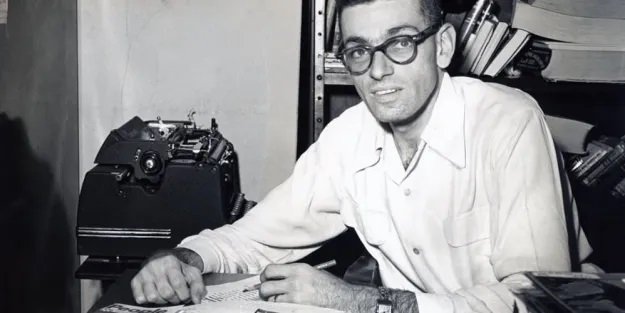
Arnold Hano


*****************************************************

addendum (June 22, 2024):

I received as an email the following comment today:

All these paragraphs and flowery words for one line drive?

“And yet I was not immediately perturbed.” ????????

Yes, it was a great catch.  No, this is anything but good writing.

It’s hard to believe anyone could not appreciate Hano’s piece or show such ignorance.

It should be obvious, but what is notable about Hano’s piece is how he AVOIDS flowery words (purple prose) and lets the concise narrative speak for itself. Instead of, say, going on and on to applaud Mays’s catch.

If the commentator (this reader) were asked to list some of the flowery words in this piece, they would be able to come up with hardly any.

Perhaps it is a lack of knowledge or experience of journalism.

I, of course, know what such a piece entailed. And I know what it takes to write on deadline with a strict word limit.

Almost no professional writers would agree with this respondent’s assessment; and I suspect very few readers.