“her” instead of “him”; Ms.; and what else?


The reflections of mine which follow concern a point of grammar that bothers me. The usage which I object to occurred in the following article which I was reading on Monday.

“Casualties of the Cashless Society: Those Who Get Seasonal Tips”

by Douglas Quenqua

The New York Times

December 18, 2017

Douglas Quenqua, Cashless Society


It is not a unique occurrence or example. The passage in the Times article was as follows:

“It’s a peculiar quirk of modern city life. The stock market is on fire, unemployment is down, and the average price of a Manhattan apartment is now more than $2 million. Yet good luck finding anyone with paper money in her purse.”


*****************************************************

Note “HER purse.”

I have a problem with this.

The reporter, if he wanted to be politically correct, could have used the awkward locution “his or her” (i.e., “his or her purse”), which I don’t particularly care for. (Nevertheless, I myself use it when I feel called upon by context to do so. But, I don’t feel obligated to use it. It depends upon my writerly instincts. In my opinion, that’s the way it should be. My or anyone else’s writing should be based upon personal preferences in matters of style, not a ukase from a language czar.)

But, the Times writer wants to show off his PC credentials with his in your face “her.” It is meant to produce a frisson in male chauvinist types. But, it actually amounts to “incivility,” so to speak, when it comes to conventions of language and audience expectations. By “audience expectations,” I mean those of the Times’s readers. If you think this is an extreme point of view, see discussions of how a writer should always keep his or her audience uppermost in mind as a “first principle” of composition in books such as June Casagrande’s It Was the Best of Sentences, It Was the Worst of Sentences: A Writer’s Guide to Crafting Killer Sentences. The unexpected “she,” rather than “he,” or “he or she,” produces a sensation of disorientation — and temporary confusion — in the discriminating reader.


*****************************************************

“[G]ood luck finding anyone with paper money in her purse” annoys me. I quoted the passage to a friend of mine (a male) with an advanced degree who has very liberal views on politics, affirmative action, sexism, homophobia, and other issues and asked him what he thought. He agreed with me. He didn’t like the use of “her” in this instance and said it annoyed him too.


*****************************************************

Re pronouns indicating gender, such as Ms.

I consider Ms. to be an abomination.

The abbreviation Mrs. signifies a beautiful honorific pronounced as Missus, and the honorific Miss, which is not abbreviated, has a beautiful sound (unlike the atrocious and downright ugly Ms., which is unpronounceable, but who cares? — we shall not have sexism in the workplace!). We are talking about ancient words embedded in our glorious language.

The French have the abbreviations M., spelled out and pronounced as the elegant Monsieur; and Mme and Mlle, pronounced and spelled out, respectively, as the euphonious Madame and the even more euphonious Mademoiselle. What a beautiful word.

What about the Spanish Srta. for the beautiful sounding honorific Señorita? Have the language police come up with an ugly substitute (one that does not indicate marital status) yet? I fear that they have.

I wonder if “Mademoiselle,” the 1970’s hit by the rock band Styx, will have to be retitled in the name of political correctness.

And what about the hit song “Adios Senorita” by Ivory Joe Hunter, which is still played? Title change? It’s never too late to correct the past sins of a benighted, politically incorrect lyricist.

More ominously, what about the musical Miss Saigon? Should the title be allowed to stand? Should it be changed to “Ms. Saigon”?


*****************************************************

This is not nitpicking on my part, and it is not a trivial matter. Ask New Yorker copyeditor Mary Norris, author of the best seller Between You & Me: Confessions of a Comma Queen. As she says, “Pronouns run deep.” The PC types are all for conservation (of the wilderness and the natural environment). Why do they want to tear asunder our language? Like nature, it should be conserved, which does mean embalmed or ossified.

If a reader of this blog disagrees with me, she is welcome to post a comment.


— Roger W. Smith

 December 20, 2017


*****************************************************


COMMENTS


Pete Smith, December 20, 2017

While there are silly uses of PC language (such as he/she), I disagree in some respects with this post. The use of the word purse in the NY Times sentence is important here. It might have been different if the phrase were “finding some change in her pocket” (though I’m not sure), but the image conjured is one of a woman fishing in her purse to tip a doorman so the word “her” is unquestionably called for here. (I know that men sometimes use purses too but let’s not go there).

As for Ms., Ms. Saigon would be stupid I agree. But the term Ms. originated when the women’s movement complained legitimately that for females the world was differentiating always between married and unmarried while the word Mr. applies to both married and unmarried males.

I have no problem using the word Ms.; it’s respectful of what many women want. Further, what would you call my wife, Mrs. Marsh? She kept her last name when she married me, and she is no longer married to Mr. Marsh, so in her case she is not Mrs. Marsh and calling her Mrs. Smith would be an insult. But of course, you can call her Marcia. . .

Overall, I like it when writers can word things so that the word “their” replaces “his” or “her” and I dislike it when writers go through contortions trying to be politically correct. I agree with you there. But if in an essay a writer uses his half the time and her the other half when referring to the generic personal possessive, it doesn’t bother me at all.


Roger W. Smith, December 20, 2017

You make some good points. You do have a point about a woman reaching for change in her purse vs. a man in his wallet. Nevertheless, I think the Times writer was “showing off,” hoping readers and probably his editors would admire his political correctness.

June Casagrande says a writer should always keep the reader and the reader’s expectations in mind. What the Times writer is doing is trying to impress and discombobulate the reader for no good reason.

Ms. is downright ugly.

Mary Norris dislikes — in fact, strongly disapproves of — “their” as the generic pronoun for a person (singular) whose gender is unspecified. I agree. She points out that their is PLURAL. Why should the language police be allowed to fuck up the language to conform to their agenda? I love and respect the intricacy of languages’ grammatical structures. Ralph told me, if I remember correctly, that Icelandic has manifold forms of the definite article. (Russian has no articles.) This fascinated me. Should the language police be authorized to undertake a study of Icelandic definite and indefinite articles with a review to assessing whether they need “retooling” in the name of political correctness? Should the Academie Francaise consider making nouns like “la table” neuter so that no one might, just possibly, be offended?

If a writer used “her” and “his” willy nilly in an essay — with no apparent reason or basis (an exception might be a book about Dick and Jane in which the writer switches constantly between referring to one or the other) — that would be pointless and confusing.


Luanne Castle, December 20, 2017

Very interesting piece, Roger. I had to look up the word “ukase,” by the way. As a woman, my first thought was “why is the writer zeroing in on women who carry purses to talk about tips?” Don’t men give tips? At least as often (more often in this marriage). And purses can be for men or women or that whole long list of new genders I saw the other day. So I found the focus to be very narrow. It wasn’t even politically correct, if you think about it from that perspective. I’d call it a poor writing choice. I think “wallet” would be more appropriate than “purse.” Maybe we should be relieved that it doesn’t read, “anyone with paper money in their purse.”


Pete Smith, December 20, 2017

Of course “their” is plural. You missed my point — you can rewrite the subjects to make them plural to make “their” work; I do this often.

The Times isn’t perfect, but you clearly have a bias against them.

Who are the language police? Your blog sounds like you’re one of them.

I am not suggesting that the French change the structure of the language. I am suggesting that your bias is clouding your thinking. A purse is usually “hers,” not “his” and your reaction to a very normal sentence in the NY Times article is revealing.


Roger W. Smith, December 20, 2017

I belong to the language police? That’s a good one. To get an idea of what I have in mind, read Nineteen Eighty-Four. Then read op-ed pieces and manifestos by zealous academics and language mavens on the subject. You might start with

I’m surprised you don’t know what I’m talking about with respect to the misuse of “their.” An example would be: “An applicant should be mindful of their appearance when preparing for an interview.”

I happen to admire quite a few New York Times writers and have occasionally commented on this in my posts. I think the Times is better written than practically all other newspapers. But, they do look foolish sometimes (in my opinion) when they try to be politically correct. And, it doesn’t help that they fired all their copy editors.

Perhaps I did overreact to one phrase in the Times article. It set me off. But my thinking is not clouded. My points are valid and are clearly and forcefully presented. What’s happening is scary. People are trying to retool the language for ideological reasons. It’s not that far out to suggest that “la table,” Senorita, and God knows what other fact of grammar which we took for granted and enjoyed studying in school will perhaps be subject to the censor’s knife.


Roger W. Smith, December 20, 2017

Appreciate your feedback, Luanne. Thanks. We’re on the same page. Perhaps that’s because we’re both writers who care about language. (And love learning new words like “ukase.”) We’re an endangered species!


Pete Smith, December 20, 2017

Again you missed my point. The sentence, if I wrote it, would be “Applicants should be mindful of their appearance when preparing for an interview.”


Roger W. Smith, December 20, 2017

Yes, you can rewrite it this way. But, there are many examples of misusage where “their” is used for an antecedent which is singular. See the discussion on pp. 69-70 of the Mary Norris book “Between You & Me: Confessions of a Comma Queen.”


Pete Smith, December 20, 2017

So direct your complaints to people misusing grammar, not to me, OK?


Luanne Castle, December 21, 2017

We are an endangered species! By the way, I am looking forward to using “ukase” on my family history blog (about my husband’s Jewish Ukrainian ancestors). I suspect that there are many “ukases” in their past!

 

grammar (again!)


“A documentary that aired on Britain’s Channel 4 two weeks ago generated news about how much sex — or not so much — Charles and Diana were having as their marriage cratered, mostly because Charles could not get over his one true love, Camilla Parker-Bowles, the Duchess of Cornwall, who he later married.”

— “Princes William and Harry are all grown up, and their mother would be proud,” by Karla Adam and William Booth, The Washington Post, August 28, 2017


*****************************************************

These two reporters do not know that it should be WHOM he later married.

If, like me, you were carefully taught the eight parts of speech in elementary school, you would have learned that there are such things as PRONOUNS; for example, the pronoun who and its variant form whom.

This would have enabled you (as it did me) to better understand how language works. A pronoun such as who when it is a subject is who, but when it is an object, it becomes whom. Elementary, my dear Watson! So we were taught by prim fussy schoolmarms eons ago. (Don’t ask me to explain why this type of variation — in spelling — occurs with pronouns and not nouns.)

But now, it’s considered to be too much to ask schoolchildren to be taxed with such lessons. And, it also seems to be considered a waste of time.

I would be willing to bet that a lot of schoolteachers nowadays don’t know the parts of speech themselves, or how they function.


— Roger W. Smith

  August 29, 2017


*****************************************************


COMMENTS


Carol Hay

August 29, 2017

“Prim fussy schoolmarms”? Rather sexist and stereotyping of teachers. Is that what I was? And how do you know teachers no longer teach grammar? I and my colleagues did! Many students rarely read these days; perhaps their not learning grammar very well is due more to this fact rather than poor teaching.

Very insulting, condescending, and ignorant comments about teachers.

Thomas P. Riggio

August 29, 2017

Technically you’re correct, of course. But common usage nowadays has dumped the distinction, at least in the USA. I think because “whom” sounds so British and a bit academic. It’s gone the way of which and that! Language and usage is always evolving.


Roger W. Smith

August 29, 2017

Tom -– former (?) New Yorker copyeditor Mary Norris does a great job of addressing such issues in Between You & Me: Confessions of a Comma Queen, sensibly. She’s a stickler for correct grammar, but takes great pains to show why it matters and why we should care. She also tackles thorny issues of usage such as when to use which vs. that.


grammar anyone?


“white nationalists, counterprotestors, violently clash”

— CNN


*****************************************************


There should not be a comma between “counterprotestors” and “violently.”

The way it’s punctuated, it would appear that there is an apposition indicating that the white nationalists are one and the same group as the counterprotestors.

Grammar! it’s gone the way of the curtsey.


— Roger W. Smith

   August 12, 2017

subject-verb DISagreement


” ‘The racism and deadly violence in Charlottesville is unacceptable but there is a better way to remove these monuments,’ Gov. Roy Cooper (D) said via Twitter on Monday evening.”

— “Protestors in North Carolina topple Confederate statue following Charlottesville violence,” The Washington Post, August 15, 2017


*****************************************************

Does anyone know (let alone care) that a plural subject takes a plural verb? This grammar rule is violated routinely — all the time. Not only by public speakers and journalists — both in speaking and in print — but also, incredibly, it is routinely violated by academics.

When you come to think about it, this is not all that surprising. After all, grammar isn’t taught in elementary schools any more; this has been the case since around 1970. It was considered too old fashioned, something prim schoolmarms used to fuss over.

I am very thankful that I had such teachers. They taught such things as sentence structure, the parts of speech, and the difference between a subject and an object. Heaven forbid, they even had us diagramming sentences!


— Roger W. Smith

   August 2017

kudos


Writers hunger for understanding and appreciation (as well as readers).

A few readers of this blog, besides disagreeing (often vehemently) with my point of view, as reflected in some of my posts, have also critiqued my writing.

I have been accused of “braggadocio” and pomposity in my posts and of defects in writing such as trying to impress readers by using big words and a weakness for overly complex wording/sentence structure. And, of using arcane scholarly references in what is deemed an effort by me to show off my learning (such as it may be).

But others with whom I have shared my writings or have discussed this say that, on the contrary, my writing is the opposite in many respects: that it exhibits humility of spirit (“sure!” my detractors would say), honesty and sincerity, and a desire to make myself clear (read simplicity; of course, my detractors would say that my writing is NOT clear).

I was going through and cleaning up old papers today. I found that I had made a note of a remark my former boss at a consulting firm where I was employed for over twelve years made to me on August 11, 1990. He told me that his wife (a retail executive who became CEO of a large department store chain) had said to him: “He writes better than you.”

Whereupon my boss said to me: “You write with a clarity of expression that takes complex issues and makes them understandable.”

Like most people, I’ll take compliments wherever I can get them.


— Roger W. Smith

    August 20, 2017


*****************************************************

addendum:

My wife read this post today. She emailed me as follows: “Roger —this is not the first time that someone has said this about you. Don’t let it go to your head [meant jocularly].”

She reminded me of a remark a friend of hers, an English teacher, once made to me. Her friend said she had enjoyed published writing of mine that my wife had shared with her and made a statement to the effect that I could write well and convincingly about anything and make it interesting. I recall the words she concluded with: “You could make a doorknob interesting.”

Am I full of myself, or what?

“pure naturalness and truth”


“[P]ure naturalness and truth, in whatever age, still find their time and their place.”

— Michel de Montaigne


So do I believe.

And earnestly wish.

I myself have strived to achieve “pure naturalness and truth” in my writing. Here and elsewhere. In writings and communiques, public and private.

Some narrow minded, mean spirited critics, who feel it incumbent upon themselves to keep an eagle eye on this site, feel otherwise. They are always carping and finding fault. They never have a complimentary word for my writing. In fact, incredibly, they find me to be pompous and feel that I pay fast and loose with “the truth,” as they see it. This, they feel, makes them entitled to correct and scold me, instead of offering constructive criticism.

My most admired writers, those whom I wish to emulate, include, along with Montaigne, Samuel Johnson and (in various works, including prose) Walt Whitman. It’s unlikely that my detractors are well acquainted with their works.


— Roger W. Smith

    September 2017

manifesto (my response to critical comments on my posts)


Montaigne wrote about everything under the sun; he’s my model. Samuel Johnson in his essays did something similar. A former English teacher colleague of my wife told me once, “You could write about a doorknob and make it interesting.”

I’m a writer, not a professor, policy wonk, or doctor.

I do not pretend to expertise I don’t have or put on airs.

I write ESSAYS. I know they are consistently good and of a consistent level of excellence. If you like good writing, you will like my blog. Which is my followers keep coming back, regardless of subject matter.

I write from personal experience. MY experience. Which is exactly what Montaigne did. Which is what good writers do. If I tried to write from an omniscient stance and pose as an authority, my writing would fall flat. Any writer will give the same advice: write about what you KNOW (and have experienced).

It is not surprising that some people will not find my writing interesting or appreciate it. To appreciate it, you have to be able to appreciate good writing.

If I write about Mozart, I’m not fooling myself that I am an authority. But I think that the writing is good and interesting. That’s what matters. If someone wants a self-help piece, or to bone up on history or politics or classical music, my blog is unlikely to be of interest or value to them. Its appeal lies solely in its excellence of writing.

I do do an awful lot of background research to ensure that my pieces are factually accurate and that I have covered the material. I rarely make factual errors or wild assertions or claims. This is different from stating opinions, when it’s clear that that’s what I’m doing.

Good essay writing should have a point of view. We’re not talking about a scholarly monograph. But, when I provide facts or background material, it’s usually reliably accurate.

Some of my writing is whimsical, impressionistic, or what have you. A light piece playing with or sometimes floating an idea or trying to convey an impression or mood. This is well within the essay writing tradition.

I don’t know quite how I would compare alongside acknowledged masters. But, I am convinced that my essays are very good and worth reading mainly for the pleasure and enlightenment that can be derived from good writing.

An artist paints in his studio. A lot of what motivates him is the pleasure of painting and doing it well. Once you’ve gotten good at something, it’s a lot of fun to keep doing it. You get pleasure every time, and there’s a feeling of self-affirmation.

The artist wants his work to be exhibited … craves recognition.

The pleasure of writing well, of meeting my own standard of excellence, is its own reward. I know when I’ve done justice to a topic and met my own high standards. There’s great satisfaction in carrying it off.

A lot of my pieces probably don’t seem that substantial. But, if one looked closely, they would see the craftsmanship and how well done they are. Yet, think of all the people who buy a pair of shoes or a bottle of wine with no idea which ones are best or appreciation of what production entails.

Largely because of having had professional experience, I know I’m not fooling myself when I say my stuff is good, unlike a lot of people who fancy themselves writers or poets. But I know what I can and cannot do. I do not write fiction or poetry. It’s a matter of what kind of writing I am qualified or prepared to do, not whether I can or cannot write well.

I have a small, slowly growing coterie of followers. I get great satisfaction out of their positive feedback and knowing I have reached them. It speaks well for me and them that they are discerning readers who can see the person embedded in the piece as well as the words and who appreciate my range of interests and integrity.

That’s enough for me — it means so much to me — but I do crave recognition and believe I deserve it.

The best man at my wedding, Charles Pierre, is a poet who had at that time just self-published his first book of poetry. He always made it clear that, in his opinion, he was good, despite not getting recognition, for the most part. I know very little about poetry, but I read his poetry and somehow, I knew that what he claimed was true.


— Roger W. Smith

   February 2018

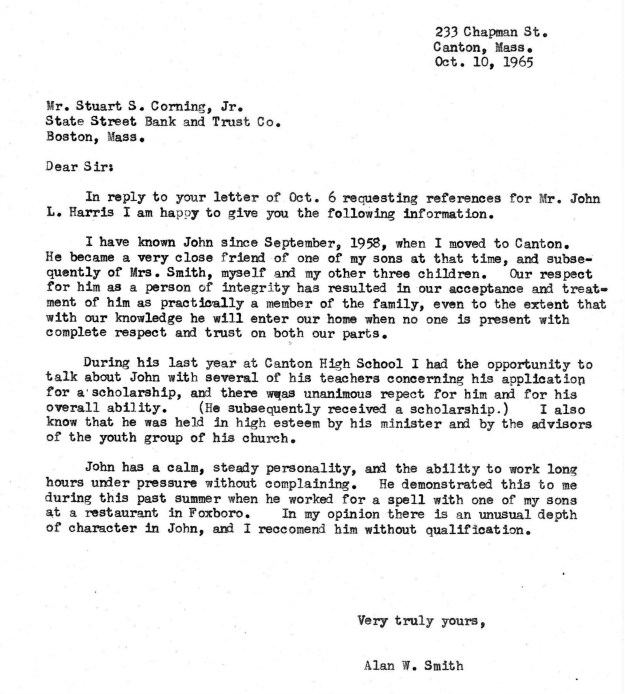
a letter of recommendation


60892770


My father wrote this recommendation for my good friend John Harris in October 1965. John was a 1963 graduate of Canton High School in Canton, Massachusetts.

I feel that my father’s letter of recommendation demonstrates – provides one small example of – how well he could handle any writing task.

I have found that various samples of writing can teach you a lot about writing in general. This includes both good and bad writing.

In the case, of bad writing, I find that it sometimes enables me, by comparison, to become more aware of what the difference between good and bad writing is, and thereby to see more clearly what the ingredients of good writing are.

Similarly, one can learn a lot about good writing both by reading and appreciating the works of the masters – an Edward Gibbon or Charles Dickens, say – and by examining pieces of everyday writing – including those of young people and of adults who are not necessarily of English prof caliber – when it is apparent that there is an innate gift for expression and an ability to convey ideas and feelings. It could be a letter not intended to be “literary,” for example.

What I notice in my father’s writing:

GRACE – his prose is always graceful, regardless of what he is writing about, whom he is writing to, or how important the topic may or may not be.

CONCISENESS – he says just enough, no more or less. There are no unnecessary words.

CLARITY – his prose is crystal clear.

COHERENCE – the sentences and paragraphs are tied together seamlessly, like a well made piece of clothing.

IT FLOWS – the exposition proceeds logically and straightforwardly. There is no discontinuity.

TONE – it is just right for target audience. There is awareness on the writer’s (my father’s) part of who his audience is – whom he is writing TO – and of the kind of language and tone that should be employed for that target audience.

CHOICE OF SUBJECT MATTER – he uses appropriate, telling examples, the best ones he can think of, to get his points across. He has gone through his mental storehouse of impressions and memories to come up with the best examples. He has chosen the ones that best fit. Then, he has plugged them into the letter in just the right places, where they support the key points being made.

ORGANIZATION – the organization is not really noticeable, which is not to say it is flawed. It is not noticeable because it doesn’t require attention. One can follow the logic of the communique with no special effort required. There are a logic and orderliness to the way the letter is constructed. Points follow in the order that makes most sense. (This, by the way, is not true of a lot of writing. Poor organization can tire a reader trying to follow what is being said.)

EMPHASIS – this is something my high school English teacher commented upon that many writers seem to be either unaware of or unable to achieve. The letter is constructed in such a way that key points are highlighted without this being obvious. I believe that the ability to achieve this is a mark of a master writer.


**********************************************

I have thought about writing at this level of excellence (as I deem this short, perfunctory communique to be) and have concluded that in writing, many of the principles that apply also apply to music. For example, a composer must achieve a logical progression to his piece; he can’t be, or at least shouldn’t be, bombastic; he needs to hold the listener’s interest and to be able to convey musical ideas in such a fashion that they are not utterly incomprehensible and “take hold” upon the listener.

Which brings us back to the topic of EMPHASIS.

In good music, you feel that there is something inevitable about the “logic,” the flow of the music. You feel it sort of HAD to be constructed that way. You feel the piece could not have been composed differently.

I would contend that my father’s letter, while perfunctory in one sense, shows some of the same qualities. You get the feeling that there was only one kind of letter of recommendation that would do for this particular individual (my friend) in this situation, and that my father managed to write just that letter.

************************************************

I myself have often felt, when writing, that there is some kind of abstract, perfect piece of writing — appropriate to, called for, as pertains to — whatever I am writing about – just what needs to be said about this or that topic (say, a book under review) – and that I have to “find” the absolutely perfect words, not only so that they are expressed perfectly, but also that they are just what needs to be said about this or that topic, and that they cover it fully. In other words, it’s a question of both prose (wording) and subject matter (content).

It’s kind of like the search for the Platonic ideal.

So that the examples chosen to make the point are just the right ones. Say, it’s a book review I am writing, for example. This would mean that I have discussed exactly those parts of the book that merit or require discussion, that I have found exactly what passages should be quoted, and have come up with the best analogies or comparisons that must be made to other works with which this book should be compared.

Searching for the best examples, for just the right things to say, can make writing very difficult, indeed exhausting. Many pieces are not written this way. They are tossed off, written in haste. (A writer notorious for this who comes to mind is the historian A. J. P. Taylor; many op ed writers compose in this fashion.) Such writing can be adequate, but it does not have the staying power of a piece that a great deal of thought and effort have been put into.

I think my father did something similar here. He thought of just what needed to be said about my friend. He chose the best examples: marshaled them. Then, he succeeded in presenting them in the most effective possible fashion.

A further word about emphasis. In writing, as in music, emphasis, which is to say putting the weight where you want it to fall — making the reader (or listener) come to attention — can be achieved in many different ways. It could be a short, punchy sentence or phrase (“I recommend him without qualification”) or it could be something elaborate and wordy. It depends.

Variation often helps here, which means variety of pacing and tone and an admixture of the terse and direct with more high flown, wordy, abstract language. Composers do this all the time: a short musical phrase followed or preceded by a long intricate passage.


— Roger W. Smith

   April 2016

A Walt Whitman Letter; and, What Can Be Inferred from It about Letter Writing in General


Camden [NJ]

Friday noon, 26th Sept.


Dear son Pete,

Your letter of yesterday came this forenoon—that was a rather serious runaway of cars in the tunnel a week ago—& mighty lucky to get off as you all did—Pete I got a few lines from Parker Milburn—he told me you had a very bad sore on a finger of right hand—they are plaguey bad things—I am in hopes yours will partly make up in giving you a little resting spell. I sent you “the Children of the Abbey,” an old novel that used to be all the rage—did you get it? To-day here is a great turn out & dedication of the Masonic Temple in Philadelphia—it is truly a handsome & noble building. A rain last night here, & to-day is really perfect. The Camden free masons marched by here this morning, about 250, the finest collection of men I thought I ever saw, but poor music, all brass, a lot of fat young Dutchmen, blowing as if they would burst, & making a hell of a hullabaloo—

Pete I am about the same—may be a little improved in general strength—had bad spells a good deal all the earlier part of the week—some very bad—but feel better yesterday & to-day—I am making some calculations of the cool weather—think it may be favorable to me—did not go out any yesterday—shall try to get out this afternoon a couple of hours—I don’t know a soul here,—am entirely alone—sometimes sit alone & think, for two hours on a stretch—have not formed a single acquaintance here, any ways intimate—My sister-in-law is very kind in all housekeeping things, cooks what I want, has first-rate coffee for me & something nice in the morning, & keeps me a good bed & room—All of which is very acceptable—(then, for a fellow of my size, the friendly presence & magnetism needed, somehow, is not here—I do not run foul of any)—Still I generally keep up very good heart—still think I shall get well—When I have my bad spells, I wait for them to fade out—I have got a letter from Charley Towner—I am finishing this by the open window—still in the rooms where my mother died, with all the old familiar things—but all drawing to a close, as the new house is done, & I shall move on Monday.
Walt.

— Walt Whitman to Pete Doyle, 26 September 1873


*************************************************

This letter was written when Whitman was living in Camden, New Jersey with his brother George Whitman, a Civil War veteran, and Walt’s sister-in-law Louisa Whitman, George Whitman’s wife.

Peter George (Pete) Doyle (1843-1907) was a great friend of Walt Whitman’s and a very important person in Whitman’s emotional life.

Though the details of Whitman’s sexuality remain murky, it appears and has been asserted by Whitman biographers that Whitman and Doyle were lovers. They met in Washington, DC in 1865 when Whitman was employed there as a civil servant and Doyle was employed as a horsecar conductor. Whitman was a regular passenger on Doyle’s car.


For an excellent biographical sketch of Peter Doyle, see

http://whitmanarchive.org/criticism/current/anc.00155.html


*************************************************

Commentary:

I read the selected letters of Walt Whitman about 25 years ago. They were an eye opener for me.

I consider myself a very good letter writer. I got this from my family. Everyone — my parents and siblings; my maternal grandfather Ralph E. Handy; my uncle Roger H. Handy; my great-aunt Etta H. Handy; and others – seemed to know how to write a good letter. It was as if it were part of their genetic makeup.

I began writing letters at an early age – the first was one that I labored over, to my third grade teacher at the end of the school year in 1955, to wish her a happy retirement.

I learned early to have an awareness of things like audience (to whom was I writing); the required degree of formality; using personal details to bring the letter alive (what I was up to if, say, I was away during the summer and writing home); others whom I should mention as wanting to be remembered to; inside jokes and personal allusions (those that only the reader or readers would be likely to get, thereby establishing rapport and a baseline of familiarity); following conventions of respect and politeness where required; writing thank you notes; and so on.

Whitman’s letters reinforced and strengthened my awareness of the importance of all these elements of good letter writing. And, they corroborated what I already basically knew, but became acutely aware of thanks to Whitman:

the best letters are often not “literary”;

simplicity and directness are keys;

plain, homely, everyday details make a letter a live piece of human tissue instead of a bloodless specimen.

Walt Whitman’s letters are wonderful, eloquent, beautifully written. Yet, what is most notable about them – besides, and along with, their directness, lack of pretension, and sincerity — embodying all of these things – the chief thing — is their SIMPLICITY. He wrote great letters that are at the same time absolutely simple ones, so that it didn’t matter to whom he was writing, an unlettered person or an educated and/or literary minded one. It didn’t matter. He carried on a correspondence with Ralph Waldo Emerson; with English literati who admired his works; with his English admirer and would be lover Anne Gilchrist; with his mother; with his brothers George and Jeff; with his sister-in-law Martha Mitchell Whitman; with the streetcar conductor Pete Doyle; and with countless other persons familiar and not familiar to him, high and low.

Every letter of Whitman’s exhibits the qualities enumerated in the previous paragraph. He was not capable of writing otherwise. The letters lay bare his sincere, unaffected, warm and loving personality and show the joy he took from the ordinary things of life (a glorious day, a ride on an omnibus up or down Broadway; or a “capital beefsteak,” for example) — especially from human relationships. These things meant everything to him.


— Roger W. Smith

  January 2017

further reflections upon my post “the greatest country” (and about the writing process)


I have received (much to my surprise) harsh criticisms over the past couple of days in response to a new post of mine:

“the greatest country in the world”

“the greatest country in the world”

It appears that I have committed “thought crime,” that I am guilty of the unpardonable sin of having stated, in the conclusion of my post: “Jingoism aside, we do live in the greatest country on earth. … We are so lucky to. It’s a blessing that is often taken for granted.”

I guess what a critic of the post might say, if trying to be “indulgent,” was that I got carried away in writing the piece and stand in need in correction. (In another country or time, I might have been sent to a “reeducation” camp with the expectation that I would modify my views.)

What follows are some points that I made in a series of emails responding to the critic of my post. In my responses, I have tried to explain what goes into writing such a piece, as I see it, and how this relates to writing in general.


— Roger W. Smith

   January 28, 2017


****************************************

email, January 24, 2017

It’s a piece of WRITING whereby I, leveraging off something that occurred to me while watching a film, engage in some recollection and reflection.

My key point was that I heard something once that was meaningful and made sense to me, personally (it’s a personal essay, not a position paper); that I learned from it and it was good for me to hear. So, the essay follows a train of thought, arising from personal experience, and focuses on a key idea or thought, which, taken out of context, could perhaps be criticized, but within that context, made a lot of sense to me.

Weren’t we taught in high school that an essay should have a topic sentence and a key point? My English teacher called this unity, a key ingredient of good writing.

I thought it was a good piece of writing. You didn’t. Hypercriticism and taking it apart would eviscerate it. There would be nothing left to say.

A writer remembers something, reflects upon it, tries to run, so to speak, with that thought, impression, sentiment, or idea. Novelists do this and they get picked apart, analyzed, and critiqued to death for things like faulty sentences and muddled thinking.

Not productive.


****************************************

email, January 23, 2017

I didn’t mean to insult anyone. The TONE of the piece — an important aspect of expository writing – is not arrogant, which term you use to describe my post. What my former therapist (whom I quoted in the post) was saying was that — from his point of view — there was no place like this country. It was a remark of admiration on his part (almost wonder), or appreciation.

Of course, other countries have claims. It’s like saying, “I love New York. It’s the greatest city on earth.” Hyperbole. Of course, I know that perhaps that’s not true, that some other city may be better — if not in my, then in someone else’s opinion. Perhaps I myself have visited or will visit such a place. (And, then, of course, one could endlessly compare the merits of one place — city or country — – vis-à-vis another, from beaches and woodlands to cities, cultural institutions, hotels, cuisine, and so forth.)

One can cite statistics and so forth to show that America can be said to NOT be “the greatest” country by various measures; however, it is not material to my blog that the US is 47th in infant mortality. This wasn’t a post about metrics. It was a simple piece about a feeling or intuition I had based on something I just saw in a movie, which reminded me of something a significant person in my life once said to me.


****************************************

email, January 23, 2017

I did not say that we are better than others (e.g., foreigners).

I wrote that my former therapist said: “Let’s face it. America is the greatest country by far. No question.” In the next sentence, I tried to convey in the post how I understood the remark — in context. I immediately followed up, in other words, by saying that he didn’t mean it (as I understood his words) as jingoism; what he meant is that the USA was the best place to LIVE in.

His remark, taken out of context, may seem wrong. But, it was made as part of a CONVERSATION. It was sandwiched between a few other words, and made in a conversational context, in which one has to infer the intended meaning. One doesn’t just sit there jotting down words or tape recording them, so that you can prove error in a particular phrase or dispute what was said.

Obviously, the statement that “America is the greatest country” — taken out of context — can be disputed. My blog post was an attempt to put the words in context and to show how, in that context, they made sense to and had meaning for me.

It was someone expressing an emotion, a feeling about a place, such as I have about living in New York City.

You note that I repeated something (America is the greatest country) three times, which seemed to vex you as a reader. I did. For the sake of repetition (a rhetorical device), and because the thought occurred to me as follows:

1. when the Tom Wolfe character says it in the film;

2. my former therapist having once said it, as I suddenly recalled;

3. me saying it at the end of the post by way of recapitulation.

I do not know exactly what the Tom Wolfe character says in the film when he gets off the boat and meets his editor, Max Perkins. I was quoting as best as I could from memory. I tried to find the film script on the Internet, but it is not available.

You made the point, by way of rejoinder, that the USA is not a great country for everyone. “For blacks in Watts?” you ask.

Every country — I am sure it’s true of Luxembourg and Saudi Arabia — has downtrodden people. This is beside the point as far as my blog post goes. I was trying to make a general observation or point about Wolfe’s and Dr. Colp’s point — that, hearing it, I thought, “you know what, America really is a great place.” Am I permitted to entertain such a thought notwithstanding the related thought that it’s not great and never has been for large swaths of the population?

When one writes a personal essay or blog, one has to be entitled to follow one’s thoughts. A train of associations: the film, my musings, Dr. Colp’s remark, my previous anger at our government and anti-American feelings (shared with many students of my generation at the time), and so forth. That was my focus.

Maybe Dr. Colp didn’t say it in quite the way you would have liked him to have said it.

Maybe I didn’t phrase it quite the way you would have liked me to, or state my conclusion in the words you would have used.

I wrote the blog.

Next time, perhaps I should confine myself to writing something like: “I think America is a nice place to live despite its imperfections. l personally like living here.”

Should I confine myself to saying that, it would probably not offend anyone. It would be a dull piece not worth reading. And, it would not accurately reflect my experience.


****************************************

email, January 23, 2017

The post was not written in an arrogant spirit and was not meant that way.

There was nothing xenophobic about what I said.

The thrust of it was, I am very happy about my good fortune to be able to live in America.

The statement that the USA is a great country is a generality which obviously doesn’t apply to everyone, to each and every place or situation.

Sometimes one entertains, is struck by a thought which runs counter to one’s previous thinking, what might be called a heuristic or “pregnant” thought.

“Heuristic” or “pregnant” in the sense that my former therapist’s remark was for me those things: revelatory, inducing reflection and modification of thought and opinions I hadn’t questioned. It made me think anew about something — not right away — but I thought about what he said and thought to myself that perhaps my UNpatriotism notwithstanding, I was fortunate to live here.

Heuristic (adjective) — enabling a person to discover or learn something for themselves.


****************************************

email, January 23, 2017

What I said was that I did not think that my therapist’s remark was made or intended to be taken in the jingoistic sense, but meant that America was a great place to LIVE.

Also, I was leveraging off a very similar comment made by the Tom Wolfe character in the film, which brought my therapist’s comment to mind.


****************************************

email, January 23, 2017

I am totally at the opposite pole from being a xenophobe or an America First, “my country right or wrong” type. (Few people know that that remark was originally made by nineteenth century naval hero Stephen Decatur. I happen to know this since I once wrote an educational play, which was published, for students in social studies classes about Decatur’s exploits.)

I have always embraced and admired foreign cultures.

I believe this should be evident in many respects, from language study to my friends to my intellectual and cultural interests and enthusiasms. It goes back to my experience attending conferences of Student Religious Liberals; French, Russian, and Spanish courses; and my admiration of Pitirim A. Sorokin and Russian culture when practically everyone seemed to be anti-Soviet and regarded the USSR as mortal enemies to be feared and distrusted.


****************************************”

email, January 23, 2017

I took my former therapist’s comment at face value. I don’t think he meant to imply that there weren’t other great countries, places, or countries; or that we as a nation have always been right, which jingoism would seem to imply. What he meant was that — for various reasons — America is a wonderful place to live and has, at the minimum, much to offer. I agree with what he said in the sense that it was taken and understood by me.

I am glad he said this to me, given how unpatriotic I tended to be in those days.