Tag Archives: Roger Smith

Emerson on Montaigne


Emerson, ‘Montaigne; Or, The Skeptic’


I was eager to read Ralph Waldo Emerson’s essay “Montaigne; Or, The Skeptic,” which was published in his Representative Men: Seven Lectures (1850). I was disappointed and had a similar experience in reading Emerson that I have discussed in an earlier post:

Non-Sequaciousness (Emerson; also Carlyle)

Non-Sequaciousness (Emerson; also Carlyle)

Among the objectives of my posts on this site is to discuss “bad writing” and why even purportedly good writers fail.

I am very interested in Montaigne. I wanted to know what Emerson had to say about him. On about the seventh or eighth page of the essay, I found what I was looking for.

I found it tough to wade through the long introduction, and I had to dig and “extract” the stuff that I was interested in and the ((to me) salient points from a mass of glowing verbiage.

In his essay on non-sequaciousness (published in 1900) , Patrick Dillon states

… Emerson is, of all modern writers, the least fitted to be relied on as a literary model. The sparks he emits and the shocks he causes are dazzling and exciting; and his ideas are brilliant as the cascade’s spray; but it will be admitted that the effect of such a writer, taken as a model £or literary novices, must be in the last degree disastrous. The youthful mind is vastly inclined to vagueness, and, like Milton’s spirits, “finds no end, in wandering mazes lost.” Whatever, then, tends to encourage this tendency, must be fatal to that ratiocination, which, says Cardinal Newman, “is the great principle of order in thinking, reducing chaos to harmony.

Try reading the first few pages or paragraphs of Emerson’s essay for yourself.


— posted by Roger W. Smith

  November 2023

an obliterated artwork … jejune writing


See my post:

an obliterated artwork … jejune writing


Roger W, Smith

   October 2023

George Eliot — again


Life did change for Tom and Maggie; and yet they were not wrong in believing that the thoughts and loves of these first years would always make part of their lives. We could never have loved the earth so well if we had had no childhood in it,—if it were not the earth where the same flowers come up again every spring that we used to gather with our tiny fingers as we sat lisping to ourselves on the grass; the same hips and haws on the autumn’s hedgerows; the same redbreasts that we used to call “God’s birds,” because they did no harm to the precious crops. What novelty is worth that sweet monotony where everything is known, and loved because it is known?

The wood I walk in on this mild May day, with the young yellow-brown foliage of the oaks between me and the blue sky, the white star-flowers and the blue-eyed speedwell and the ground ivy at my feet, what grove of tropic palms, what strange ferns or splendid broad-petalled blossoms, could ever thrill such deep and delicate fibres within me as this home scene? These familiar flowers, these well-remembered bird-notes, this sky, with its fitful brightness, these furrowed and grassy fields, each with a sort of personality given to it by the capricious hedgerows,—such things as these are the mother-tongue of our imagination, the language that is laden with all the subtle, inextricable associations the fleeting hours of our childhood left behind them. Our delight in the sunshine on the deep-bladed grass to-day might be no more than the faint perception of wearied souls, if it were not for the sunshine and the grass in the far-off years which still live in us, and transform our perception into love.

— George Eliot, The Mill on the Floss

MARVELOUS


— posted by Roger W. Smith

   June 2023

The best way is not always the shortest.


My wife called something to my attention  in the New York Times this morning. She had a problem with the second paragraph in the following story:

“On Eve of Trial, Discovery of Carlson Texts Set Off Crisis Atop Fox”

By Jim Rutenberg, Jeremy W. Peters, and Michael S. Schmidt

The New York Times

April 26, 2023

The second paragraph read:

Private messages sent by Mr. Carlson that had been redacted in legal filings showed him making highly offensive and crude remarks that went beyond the inflammatory, often racist comments of his prime-time show and anything disclosed in the lead-up to the trial.

I think I know why the sentence ended up the way it did. Because of newspaper-writing conventions regarding conciseness. The rule or standard is: Get rid of as many words as you can whenever and wherever they can be omitted (without omitting key facts or becoming unintelligible).

But there is a problem here.

comments OF HIS PRIME-TIME SHOW is vague and fuzzy. Were they comments that Carlson alone made (this is implied, but it could also include comments made by guests/interviewees)? Were they comments that he spoke or that were posted on the screen in bullet point fashion? In my mind it’s too vague. And awkwardly worded. It seems that comments ON his prime-time show would be better (sounds better to the ear). But then that’s not clear, because it could be anyone’s comments.

The best way to say it (undoubtedly) is comments made by Carlson on his prime-time show. This adds three words (the phrase made by Carlson on replaces the word of).


*****************************************************

My post

regarding Professor Strunk’s admonition, “Omit Needless Words.” (or, are long, complex sentences bad?)

regarding Professor Strunk’s admonition, “Omit Needless Words.” (or, are long, complex sentences bad?)

is pertinent here.

I quoted Professor Brooks Landon in his lecture ““Grammar and Rhetoric” (lecture 2, “Building Great Sentences: Exploring the Writer’s Craft”; The Great Courses/The Teaching Company).

Unless the situation demands otherwise, sentences that convey more information are more effective than those that convey less. Sentences that anticipate and answer more questions that a reader might have are better than those that answer fewer questions. Sentences that bring ideas and images into clearer focus by adding more useful details and explanation are generally more effective than those that are less clearly focused and that offer fewer details.

Many of us have been exposed over the years to the idea that effective writing is simple and direct, a term generally associated with Strunk and White’s legendary guidebook The Elements of Style, or we remember some of the slogans from that book, such as, “Omit needless words.” … [Stunk concluded] with this all important qualifier: “This requires not that the writer make all his sentences short, or that he avoid all detail and treat his subjects only in outline, but that he make every word tell.” … Strunk’s concern is specifically with words and phrases that do not add propositions to the sentence [e.g., “owing to the fact that” instead of “since”].” … “Omit needless words” is great advice, but not when it gets reduced to the belief that shorter is always better, or that “needless” means any word without which the sentence can still make sense.

*****************************************************

Addendum:

My journalism school instructor, New York Times city reporter Maurice (Mickey) Carroll, taught me to tighten up my stories. His editing was invaluable. Here is an example from one of my assignments.


So I understand and appreciate the need for conciseness in newspaper reporting. But I also think Professor Landon’s astute observations should be kept in mind.


— posted by Roger W. Smith

   April 27, 2023

Walt Whitman to Anson Ryder, Jr.


Whitman to Anson Ryder, Jr. August


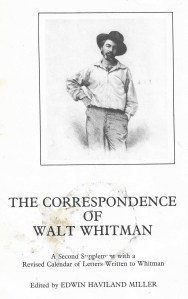
Posted here (PDF above) are two letters from Walt Whitman letter to Anson Ryder, Jr., dated August 15 and 16, 1865.


*****************************************************

A good letter mixes the general with the specific.

Emotion — feeling for the person addressed — with material that is of topical and anecdotal interest to both the letter writer and the recipient, creating a conversational-type bond.


— posted by Roger W. Smith

  March 2023

*****************************************************

See also my post:

A Walt Whitman Letter; and, What Can Be Inferred from It about Letter Writing in General

A Walt Whitman Letter; and, What Can Be Inferred from It about Letter Writing in General

parallelism


‘The ordeals of ‘litel clergeon’* and Cambridge freshman are circumstantially very different, and essentially very much the same.”

— Abbie Findlay Potts, Wordsworth’s Prelude: A Study of Its Literary Form (Cornell University Press, 1953), pg. 283

*a schoolboy in Chaucer’s The Prioresses Tale


*****************************************************

A splendid sentence by a magnificent writer.


— posted by Roger W. Smith

   March 2023

a genius for simile


Jason Gay wrote:

Baseball [has] a clock [now].

This is how it should be, and how baseball once was. Have pitchers pitch. Have batters bat. How much of your existence have you already surrendered to this maddening game, which dawdles like an oblivious customer in an airport Starbucks–a tall is the small one, right–as your flight announces its final boarding? [italics added]

— “Thought Baseball Games Were Too Slow. Now They’re Too Fast?,” By Jason Gay, The Wall Street Journal, February 27, 2023


— posted by Roger W. Smith

   March 2023

“She was like, no.”


Walking on East 28th Street today, Sunday, I passed a bagel place. Two young women were chatting at a table outside, One said (talking about a third person not present), “She was like, no. I was like … ”

*****************************************************

The use of like — how would one define it grammatically? an intensifier? — has become common among a younger generation; is something new, in terms of idiomatic usage.

Well how about my generation? I grew up in the 50s.

Cool and square. Can you dig it must have sounded strange to our parents’ and grandparents’ ears.

Like is used to signify something without being specific. She was like, angry. She was like, I can’t stand this. She may have actually said this, or said this in essence but not in these exact words.

English lends itself to flexibility and inventiveness. Think of Shakespeare, Chaucer.

This grammar purist wholly endorses like. Or at least doesn’t object to it


— posted by Roger W. Smith

   March 5, 2023


*****************************************************

Addendum

Like here seems to function as an intensifier, but that may not be the correct grammatical term. Perhaps there is no precise term to classify it.

intensifier — a word, especially an adverb or adjective, that has little meaning itself but is used to add force to another adjective, verb, or adverb: In the phrases an extremely large man and I strongly object, extremely and strongly are both intensifiers.


*****************************************************

Addendum, March 10, 2023

A friend of mine has pointed out that the grammatical classification of like is not so simple.

Let’s say one hears said: I got a C minus on my paper and I was, like, in a state of shock.

This is an example of an exaggerated statement that is almost parodies the words used. Because what the speaker is saying — means — is that they were surprised and not happy to get such a low grade but they by no means mean to imply that a state of shock was an actuality – the situation was actually a lot less bad.

“The language police come for the word ‘field’ ”


‘The language police come for the word field’ – Boston Globe 1-17-2023

After all, as that memo from the Practicum Education Department points out, “Words are powerful, but even more so is action. We are committing to further align our actions, behaviors and practices with anti-racism and anti-oppression, which requires taking a close and critical look at our profession — our history, our biases and our complicity in past and current injustices.”


*****************************************************

re

“The language police come for the word ‘field’ ”

By Joan Vennochi

The Boston Globe

January 17, 2023

We all know the basic meaning, origin, of the word field. But think of all the meanings, connotations, it has assumed. From the basic concept of a plot, an area, comes the idea of something abstract: domain, area. And this concept gets generalized. Unified Field Theory. His field of study is anthropology.

And baseball and football fields. And fielder. The left fielder occupies that position on a baseball field. An outfielder is stationed far from home plate and an infielder the opposite.

A politician fields a question. This usage may have come from baseball: the verb to field (the shortstop fielded a grounder).

Harmless enough, would you not say?

And here we have an issue being made (at UCLA) of the word. This is preposterous. Academics are engaging in entirely needless, ridiculous language policing – what seems to be an exercise in “virtue signaling.”

Is it reasonable to assume that descendants of slaves who happen to be students or staff would be “harmed” or cannot handle the word field? Can anyone be offended?

As an example, consider the word rope. Should it be banned? Ropes were used to lynch blacks in recent history. How about tree? Or the noun (or, for that matter, the verb) post? They are things and words that were no doubt were used in lynchings and in accounts of lynchings.

In the Boston Globe article. reference is made to a list of words complied by Globe editors that writers have been instructed to either avoid or “be careful with.”

Some expressions to avoid entirely because of their roots in violence against Black people, Indigenous people, or other marginalized groups, or their appropriation from Indigenous cultures and customs, include “grandfather clause”; “on the warpath”; “too many chiefs, not enough Indians“; powwow”; “long time, no see” and “no can do”; “mumbo jumbo”; and “chink in the armor.” We should also be careful with “sherpa” if we’re not referring to the Tibetan ethnic group; “guru” if we’re not referring to a spiritual leader or teacher with that title; “hysteria,” especially if not talking about a cisgender male; “crazy,” “insane,” “schizophrenic” or other mental health terms if used to describe unrelated things; and language relating to physical disabilities, such as “blindness” or “deafness,” to mean cluelessness, heartlessness, or unwillingness to listen; or “lame” to mean “undesirable” or “corny.”

Most of these recommendations (re usage by Globe staff) seem sensible and worth alerting writers to. Times do change. Think of racist insults and slurs that were once common.

*****************************************************

Getting back to the word field. Abbie Findlay Potts, in her monograph Wordsworth’s Prelude: A Study of Its Literary Form, discusses the poetic vocabulary of the young William Wordsworth (with a consideration of things such as abstract versus concrete words). She observes:

Man-made things noted, typically more than actually, are paths and walks, fields of war and listed fields, cell, dome, mansions, roof; gold, dye, chariot, fetters, sword, lance, ring, and lyre; design, book, page, and song.

Note the use of the word fields. Should an English professor refrain from teaching Wordsworth because of this?

And what about the following:

In every cry of every Man,
In every Infants cry of fear,
In every voice: in every ban,
The mind-forg’d manacles I hear

— Blake, ”London”

My goodness! Manacles were used to restrain slaves – as can be observed in pictures of slave auctions. What is to be done? I hope this favorite poem of mind doesn’t get banned.


— Roger W. Smith

  January 2020