

Gloria in excelsis Deo
et in terra pax hominibus bonae voluntatis.
Glory to God in the highest.
and peace to his people on earth.
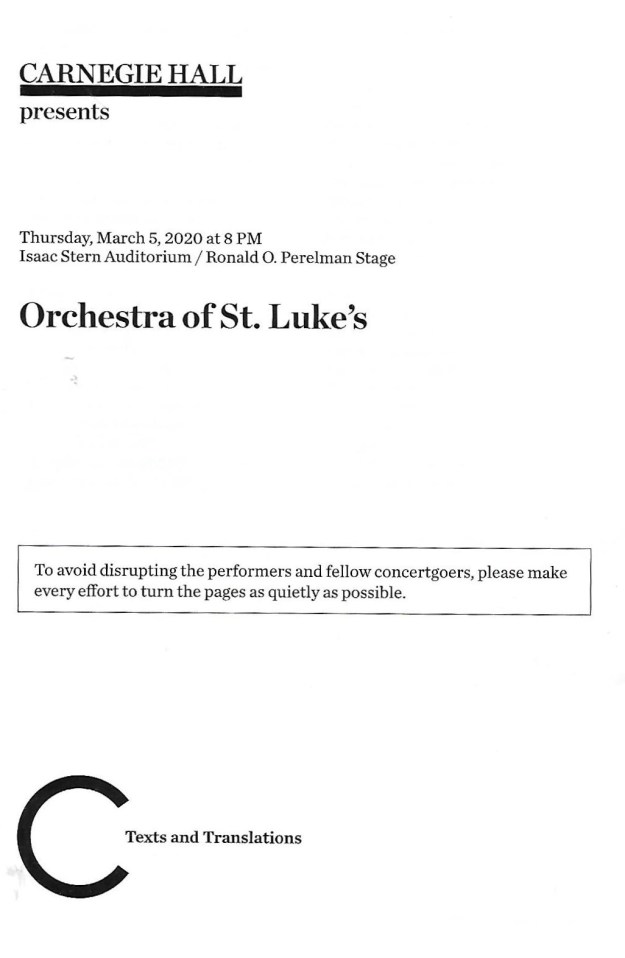
— “Gloria,” Beethoven, Mass in C Major; translation, Carnegie Hall program notes; performance by Orchestra of St. Luke’s, March 5, 2010
*****************************************************
NO — “to his people on earth” is deliberately wrong.
How can one — why would one — mistranslate unambiguous words from the Latin mass? It is
Glory to God in the highest.
and peace on earth to MEN OF GOOD WILL.
Men of good will is not a “generic” phrase. It means something. To men (yes, men) of good will.
Words have a literal meaning and a connotation. Here it is the literal meaning that is in question. In my mind, these beautiful words always have evoked the thought of a community of well-meaning people, of benevolent spirits. But the anonymous translator here (read, verbal axe-wielder) has substituted the anodyne “his people on earth,” e.g., earthlings. Presumably for the sake of political correctness. This strips the phrase of its meaning.
I am offended, deeply so, that someone would change the text of a beautiful mass by Beethoven, the text of the Latin mass which has existed for over four centuries.
— posted by Roger W. Smith
March 6, 2020
 Roger's rhetoric
Amazing that you caught this mistranslation. It’s horrible that the Latin text was mistranslated for the accompanying program notes for a Beethoven concert at Carnegie Hall. It was a devious thing to do, a mistranslation of a text by some anonymous arbiter of language driven by their own standard. What about the purity of the translation? Good work, Roger.
LikeLike
Mr Smith seems confused. The translation given, while not exact, is traditional, and has been used in English settings of the gloria since at least the early C20. It is certainly not an attempt at ‘political correctness’, and very much predates the concept of political correctness, entirely. Additionally he has fixed on a curious point, here. Hominibus is considerably less contestable than ‘bonae voluntatis.
‘Hominibus’ may historically have been translated “all men” (and hominibus bonae voluntatis as “all men of good will”), but at the time of such translation, ‘man’ was intended to mean ‘human’, in the sense of ‘mankind’. The drift in meaning is in the English, not in the Latin, and therefore while a traditional translation is acceptable, even desired in a traditional language service where the congregation understands the meaning intended, a modern translation can scarcely be said to be a ‘mistranslation’ for choosing the word ‘people’, which more closely represents the meaning of the original.
To go a little deeper, ‘Hominibus’ itself is the Vulgate Latin translation of the Koine Greek ‘ἀνθρώποις’ from the Greek doxology, meaning ‘human’. The text is adapted from gospel texts, originally written in Greek. Men was once a good translation of this word, but the current, commonly understood meaning of men to mean ‘male human’s is not in the meaning of the original. Note that man meant ‘human’, not ‘male human’, at a time when ‘wifman’ and ‘werman’ meant female and male humans, respectively. Compare modern German ‘mann’, ‘mench’, which are used for ‘person’, without reference to gender.
Summarising – ‘man’ is correct, but only in an archaic meaning of the word. ‘Person’ or ‘human’ is correct in its current meaning.
More susceptible to criticism is the translation of “bonae voluntatis”. Here the idea of “all men (=people) of good will/intent” being equated with “his people”. Clearly the intended sense is that God’s people are those of good will, but I don’t like this any more than Mr Smith does; however, I would have to call it a translation I don’t like, rather than a ‘mistranslation’. These things are rarely so black and white. Again, though, it’s quite a long-standing translation, used in many English settings of the Gloria.
LikeLike