Tag Archives: Roger W. Smith

can the sun “grin”?


I learned in yesterday’s New York Times about the passing of my former journalism professor Maurice (Mickey) Carroll, who died on December 6th.

“Maurice Carroll, Political Reporter and Pollster, Dies at 86”

By Sam Roberts

The New York Times

December 6, 2017


*****************************************************

Mickey Carroll was a tough, dapper Irish guy and an outstanding reporter on the Times’s city desk for many years. He taught me far more about writing than any of my other journalism profs; it wasn’t even close.

It’s a truism that the best way to learn any skill is to do it. Well, besides lecturing, Carroll meticulously critiqued our writing (stories we had to report and write as class assignments).

I would hand in a story to him. I remember one was when he let the class interview him press conference style and we were assigned to write a profile of him. “This is very good,” he said to me, handing back the paper a day or two later, “but it’s too long.”

I kept tightening up my work. I began to appreciate how important space limitations are in a newspaper. For a feature article, it’s usually six hundred words. Six hundred words meant just that: six hundred words. If you wrote, say, 615 words, your editor would be unhappy, having to do the work himself of excising a “graf” from your story.

I would hand in papers that I thought were as carefully and tightly constructed as I could make them, with no superfluous words. They would come back with red lines drawn though maybe ten or fifteen words or phrases that I had never realized were superfluous. A that, say, where it could be dispensed with.


*****************************************************

Professor (and seasoned reporter) Carroll told us a funny story in class one day which illustrates the frustrations he himself had experienced as a writer. He finally left the Times for another paper. He said the final straw was when he once assigned to cover the St. Patrick’s Day parade in Manhattan.

The lead sentence in the story he turned in was “The sun grinned on the Irish yesterday.”

Grinned was too colorful a word for the copy editor at the Times, which was known for bloodless prose. (It still is, but efforts have made over recent years to make the writing more lively.) For “grinned,” the copy editor substituted some more generic verb.

“That did it,” Mickey said.

I could identify with the frustrations he felt with pettifogging editors.


— Roger W. Smith

   December 7, 2017


*****************************************************

Addendum:

Sam Roberts, one of the Times’s best obituary writers, and an outstanding writer in general, wrote the obituary. He notes: “Known to be cranky but easily amused, Mr. Carroll would often pepper his reporting with wry and iconoclastic asides.”

That’s how he was in class: the teacher/editor who applied principles of “tough love” to improving the writing of his students, while doing it with wit and grace. And, he showed us how, while adhering to strict standards of newspaper writing, you could also have fun and work in a quip or an amusing detail or two. Shoehorn it in, that is, word length permitting.

“He never lost his reporter’s perspective, though, advising would-be journalists never to take themselves too seriously, no matter how important the news they’re covering may be,” Sam Roberts writes.

I found this to be true. He was a complete professional, and, as such, he was never out of character in class, yet he himself was a character.

He stressed that his vocation was that of REPORTER, and he once told a story to illustrate what that meant.

Early in Carroll’s career, a reporter on the Times’s arts desk, a cultural critic, was somewhere in Manhattan at some event or performance one evening. As he was leaving, he observed that a big fire had broken out in a building across the street. He telephoned the Times from a pay phone, shouting, “Get a reporter here immediately! There’s a fire!”

He was a reporter,” observed Carroll, who happened to be at Dallas Police Headquarters on one of his first reporting assignments when Lee Harvey Oswald was shot by Jack Ruby. “He was there. He should have covered the fire.”

“dense” writing


By dense, I mean the word in the sense of “closely compacted in substance.” which is the first dictionary definition given.

Not dense in the sense of stupid, referring to a person.

I realize that I prefer “dense” writing. By which I mean, not necessarily turgid, but packed with descriptive details and meaning.


*****************************************************

I tend to read slowly and deliberately. I often stop to read pages and passages over again, and to think about or study them. Sometimes I only read a page or two at a sitting.

The words are worth such effort and attention.


*****************************************************

The following are two examples from novels I am reading simultaneously at present.
From Louisa May Alcott’s first novel, Moods (1865, revised 1882):


Chapter I

IN A YEAR.

The room fronted the west, but a black cloud, barred with red, robbed the hour of twilight’s tranquil charm. Shadows haunted it, lurking in corners like spies set there to watch the man who stood among them mute and motionless as if himself a shadow. His eye turned often to the window with a glance both vigilant and eager, yet saw nothing but a tropical luxuriance of foliage scarcely stirred by the sultry air heavy with odors that seemed to oppress not refresh. He listened with the same intentness, yet heard only the clamor of voices, the tramp of feet, the chime of bells, the varied turmoil of a city when night is defrauded of its peace by being turned to day. He watched and waited for something; presently it came. A viewless visitant, welcomed by longing soul and body as the man, with extended arms and parted lips received the voiceless greeting of the breeze that came winging its way across the broad Atlantic, full of healthful cheer for a home-sick heart. Far out he leaned; held back the thick-leaved boughs already rustling with a grateful stir, chid the shrill bird beating its flame-colored breast against its prison bars, and drank deep draughts of the blessed wind that seemed to cool the fever of his blood and give him back the vigor he had lost.

A sudden light shone out behind him filling the room with a glow that left no shadow in it. But he did not see the change, nor hear the step that broke the hush, nor turn to meet the woman who stood waiting for a lover’s welcome. An indefinable air of sumptuous life surrounded her, and made the brilliant room a fitting frame for the figure standing there with warm-hued muslins blowing in the wind. A figure full of the affluent beauty of womanhood in its prime, bearing unmistakable marks of the polished pupil of the world in the grace that flowed through every motion, the art which taught each feature to play its part with the ease of second nature and made dress the foil to loveliness. The face was delicate and dark as a fine bronze, a low forehead set in shadowy waves of hair, eyes full of slumberous fire, and a passionate yet haughty mouth that seemed shaped alike for caresses and commands.

A moment she watched the man before her, while over her countenance passed rapid variations of pride, resentment, and tenderness. Then with a stealthy step, an assured smile, she went to him and touched his hand, saying, in a voice inured to that language which seems made for lovers’ lips–

“Only a month betrothed, and yet so cold and gloomy, Adam!”


*****************************************************

And from the first chapter of George Gissing’s first novel, Workers in the Dawn (1880):


Chapter 1

Market Night

Walk with me, reader, into Whitecross Street. It is Saturday night, the market-night of the poor; also the one evening in the week which the weary toilers of our great city can devote to ease and recreation in the sweet assurance of a morrow unenslaved. Let us see how they spend this “Truce of God;” our opportunities will be of the best in the district we are entering.

As we suddenly turn northwards out of the dim and quiet regions of Barbican, we are at first confused by the glare of lights and the hubbub of cries. Pressing through an ever-moving crowd, we find ourselves in a long and narrow street, forming, from end to end, one busy market. Besides the ordinary shops, amongst which the conspicuous fronts of the butchers’ and the grocers’ predominate, the street is lined along either pavement with rows of stalls and booths, each illuminated with flaring naphtha-lamps, the flames of which shoot up fiercely at each stronger gust of wind, filling the air around with a sickly odour, and throwing a weird light upon the multitudinous faces. Behind the lights stand men, women and children, each hallooing in every variety of intense key — from the shrillest conceivable piping to a thunderous roar, which well-nigh deafens one — the prices and the merits of their wares. The fronts of the houses, as we glance up towards the deep blackness overhead, have a decayed, filthy, often an evil, look; and here and there, on either side, is a low, yawning archway, or a passage some four feet wide, leading presumably to human habitations. Let us press through the throng to the mouth of one of these and look in, as long as the reeking odour will permit us. Straining the eyes into horrible darkness, we behold a blind alley, the unspeakable abominations of which are dimly suggested by a gas-lamp flickering at the further end. Here and there through a window glimmers a reddish light, forcing one to believe that people actually do live here; otherwise the alley is deserted, and the footstep echoes as we tread cautiously up the narrow slum. If we look up, we perceive that strong beams are fixed across between the fronts of the houses — sure sign of the rottenness which everywhere prevails. Listen! That was the shrill screaming of an infant which came from one of the nearest dens. Yes, children are born here, and men and women die. Let us devoutly hope that the deaths exceed the births.

Now back into the street, for already we have become the observed of a little group of evil-looking fellows gathered round the entrance. Let us press once more through the noisy crowd, and inspect the shops and stalls. Here is exposed for sale an astounding variety of goods. Loudest in their cries, and not the least successful in attracting customers, are the butchers, who, with knife and chopper in hand, stand bellowing in stentorian tones the virtues of their meat; now inviting purchasers with their — “Lovely, love-ly, l-ove-ly! Buy! buy — buy!” now turning to abuse each other with a foul-mouthed virulence surpassing description. See how the foolish artisan’s wife, whose face bears the evident signs of want and whose limbs shiver under her insufficient rags, lays down a little heap of shillings in return for a lump, half gristle, half bone, of questionable meat-ignorant that with half the money she might buy four times the quantity of far more healthy and sustaining food.

But now we come to luxuries. Here is a stall where lie oysters and whelks, ready stripped of their shells, offering an irresistible temptation to the miserable-looking wretches who stand around, sucking in the vinegared and peppered dainties till their stomachs are appeased, or their pockets empty. Next is a larger booth, where all manner of old linen, torn muslin, stained and faded ribbons, draggled trimming, and the like, is exposed for sale, piled up in foul and clammy heaps, which, as the slippery-tongued rogue, with a yard in his hand turns and tumbles it for the benefit of a circle of squalid and shivering women, sends forth a reek stronger than that from the basket of rotten cabbage on the next stall. How the poor wretches ogle the paltry rags, feverishly turn their money in their hands, discuss with each other in greedy whispers the cheapness or otherwise of the wares! Then we have an immense pile of old iron, which to most would appear wholly useless; but see how now and then a grimy-handed workman stops to rummage among it, and maybe finds something of use to him in his labour.

Here again, elevated on a cart, stands a vender of secondhand umbrellas, who, as he holds up the various articles of his stock and bangs them open under the street-lamps that purchasers may bear witness to their solidity, yells out a stream of talk amazing in its mixture of rude wit, coarse humour, and voluble impudence. “Here’s a humbereller!” he cries, “Look at this ’ere; now do! Fit for the Jewk o’ York, the Jewk of Cork, or any other member of the no-bility. As fo my own grace, I hassure yer, I never uses any other! Come, who says ‘alf-a-crownd for this? — No? — Why, then, two bob — one an’-a-tanner — a bob! Gone, and damned cheap too!” This man makes noise enough; but here, close behind him, is an open shop-front with a mingled array of household utensils defying description, the price chalked in large figures on each, and on a stool stands a little lad, clashing incessantly with an enormous hammer upon a tray as tall as himself, and with his piercing young voice doing his utmost to attract hearers. Next we have a stall covered with cheap and trashy ornaments, chipped glass vases of a hundred patterns, picture-frames, lamps, watch-chains, rings; things such as may tempt a few of the hard-earned coppers out of a young wife’s pocket, or induce the working lad to spend a shilling for the delight of some consumptive girl, with the result, perhaps, of leading her to seek in the brothel a relief from the slow death of the factory or the work-room. As we push along we find ourselves clung to by something or other, and, looking down, see a little girl, perhaps four years old, the very image of naked wretchedness, holding up, with shrill, pitiful appeals, a large piece of salt, for which she wants one halfpenny — no more, she assures us, than one half-penny. She clings persistently and will not be shaken off. Poor little thing; most likely failure to sell her salt will involve a brutal beating when she returns to the foul nest which she calls home. We cannot carry the salt, but we give her a copper and she runs off, delighted. Follow her, and we see with some surprise that she runs to a near eating-house, one of many we have observed. Behind the long counter stands a man and a woman, the former busy in frying flat fish over a huge fire, the latter engaged in dipping a ladle into a large vessel which steams profusely; and in front of the counter stands a row of hungry-looking people, devouring eagerly the flakes of fish and the greasy potatoes as fast as they come from the pan, whilst others are served by the woman to little basins of stewed eels from the steaming tureen. But the good people of Whitecross Street are thirsty as well as hungry, and there is no lack of gin-palaces to supply their needs. Open the door and look into one of these. Here a group are wrangling over a disputed toss or bet, here two are coming to blows, there are half-a-dozen young men and women, all half drunk, mauling each other with vile caresses; and all the time, from the lips of the youngest and the oldest, foams forth such a torrent of inanity, abomination, and horrible blasphemy which bespeaks the very depth of human — aye, or of bestial — degradation. And notice how, between these centres and the alleys into which we have peered, shoeless children, slipshod and bareheaded women, tottering old men, are constantly coming and going with cans or jugs in their hands. Well, is it not Saturday night? And how can the week’s wages be better spent than in procuring a few hours’ unconsciousness of the returning Monday.

The crowd that constantly throngs from one end of the street to the other is very miscellaneous, comprehending alike the almost naked wretch who creeps along in the hope of being able to steal a mouthful of garbage, and the respectably clad artisan and his wife, seeing how best they can lay out their money for the ensuing week. The majority are women, some carrying children in their arms, some laden with a basket full of purchases, most with no covering on their heads but the corner of a shawl.

But look at the faces! Here is a young mother with a child sucking at her bare breast, as she chaffers with a man over a pound of potatoes. Suddenly she turns away with reddened cheeks, shrinking before a vile jest which creates bursts of laughter in the by-standers. Pooh! She is evidently new in this quarter, perhaps come up of late from the country. Wait a year, and you will see her joining in the laugh at her own expense, with as much gusto as that young woman behind her, whose features, under more favourable circumstances, might have had, something of beauty, but starvation and dirt and exposure have coarsened the grain and made her teeth grin woefully between her thin lips.

Or look at the woman on the other side, who is laughing till she cries. Does not every line of her face bespeak the baseness of her nature? Cannot one even guess at the vile trade by which she keeps her limbs covered with those layers of gross fat, whilst those around her are so pinched and thin? Her cheeks hang flabbily, and her eyes twinkle with a vicious light. A deep scar marks her forehead, a memento of some recent drunken brawl. When she has laughed her fill, she turns to look after a child which is being dragged through the mud by her skirts, being scarcely yet able to walk, and, bidding it with a cuff and a curse not to leave loose of her, pushes on stoutly through the crowd.

One could find matter for hour-long observation in the infinite variety of vice and misery depicted in the faces around. It must be confessed that the majority do not seem unhappy; they jest with each other amid their squalor; they have an evident pleasure in buying and selling; they would be surprised if they knew you pitied them. And the very fact that they are unconscious of their degradation afflicts one with all the keener pity. We suffer them to become brutes in our midst, and inhabit dens which clean animals would shun, to derive their joys from sources from which a cultivated mind shrinks as from a pestilential vapour. And can we console ourselves with the reflection that they do not feel their misery?

Well, this is the Whitecross Street of today; but it is in this street rather more than twenty years ago that my story opens. There is not much difference between now and then, except that the appearance of the shops is perhaps improved, and the sanitary condition of the neighbourhood a trifle more attended to; the description, on the whole, may remain unaltered.


*****************************************************

The writing in these two exemplary novels speaks for itself. But, what I like about Alcott is the richness of description; the almost poetic use of descriptive details to create a mood; the combination of the natural, which is to say non-human but very much alive (i.e., nature, the ambience created by it) with the human. How description simultaneously becomes (and is cleverly made so) exposition: “… a black cloud, barred with red, robbed the hour of twilight’s tranquil charm. Shadows haunted it, lurking in corners like spies set there. … a tropical luxuriance of foliage scarcely stirred by the sultry air with odors that seemed to oppress not refresh. … An indefinable air of sumptuous life surrounded her, and made the brilliant room a fitting frame for the figure standing there. …”

In Gissing: the pains he takes and the lengths to which he will go to make us feel as if we are joining him in a walk along Whitecross Street: the richness of telling descriptive detail; the human element; the choice, selection, and skillful use of a plethora of details to make us experience fully what it was like in that place in that time, in London in the nineteenth century. How pure description strongly conveys with the author’s sure touch his impressions and feelings to us, so that it is more than an accumulation of details: “Let us press through the throng to the mouth of one of these and look in, as long as the reeking odour will permit us. Straining the eyes into horrible darkness, we behold a blind alley, the unspeakable abominations of which are dimly suggested by a gas-lamp flickering at the further end. Here and there through a window glimmers a reddish light, forcing one to believe that people actually do live here. …”

As an offhand remark, I would be inclined to say that I prefer such writers to more modern ones.


— posted by Roger W. Smith

   June 2018

highfalutin hogwash; pseudo intellectual inanity; pernicious pomposity, perverse pontificating (take a hike, Spiro Agnew! you too, Bill Safire!)


Two things are pertinent to this post — form a background to it, so to speak.

First, this past March, I wrote a blog post:

“Racism Rears Its Ugly Head”

Racism Rears Its Ugly Head

about objections to a painting by the artist Dana Schutz based upon photographs of the mutilated body of Emmett Till, the black teenager who was murdered by two white men in Mississippi in 1955, which was featured in the 2017 Biennial exhibition at the Whitney Museum of American Art in Manhattan. Protests had arisen over the work. I am in principle opposed to the destruction of art for reasons of political correctness.

Secondly, I am working on a post of my own about the craft of writing. I want to be able to illustrate it with examples of both good and bad writing.


*****************************************************

With these things in the back of my mind, I read an op-ed piece in yesterday’s New York Times which stopped me cold, that was so bad it was unbelievable. I thought to myself, how did it get published? I posted an angry comment on the Times site, but the comment did not get posted. No doubt, the Times editors found it inappropriate. Strange, because often comments posted in response to Times opinion pieces are not well written or articulate; and, in fact, many are obtuse and display ignorance and lack of acumen.


*****************************************************

The piece that has astounded me with its badness and inanity is

“The Art of Destroying an Artwork”

by David Xu Borgonjon

The New York Times

October 25, 2017

Borgonjon Destroying Artwork

‘The Art of Destroying an Artwork’ – NY Times 10-25-2017


The Times article merely indicates that “David Xu Borgonjon is a curator and writer.” Googling him at

http://laundromatproject.org/david-xu-borgonjon/

I found out that “[David Xu Borgonjon] is a curatorial fellow at Wave Hill and is the co-founder of Screen, a bilingual Chinese and English platform for media art commentary. Currently he is preparing a series of “Strategy Sessions” for Summer 2015, a professional development workshops for artists using board games as metaphor. David has coordinated the Gallery of the Women’s Center at Brown University (where he graduated in 2014 in English with honors in a Dual Degree program with the Rhode Island School of Design).”

And so forth. The information on the site may be slightly dated. Wave Hill is a 28-acre estate in the Hudson Hill section of Riverdale, Bronx, in New York City which consists of public horticultural gardens and a cultural center which includes an art gallery.


*****************************************************

One has to read Mr. Borgonjon’s piece in full to get a feel for its awfulness. It is a textbook example of flawed writing built upon cockeyed premises. A key problem is that the piece is too abstract, is not tethered to fact. One might ask, what’s wrong with a conceptual piece of writing, with exposition for the sake of exposition? Is there such a thing as too abstract? Yes, there is, and Mr. Borgonjon’s horribly written piece shows how this can occur.

It’s very hard to even figure out what he is talking about. One has to wade through the piece, which is tortuous reading, a ways to get some idea of what he is talking about. This, right away, indicates a problem. There are some would be intellectuals/thinkers and writers who seem to think that nebulous writing is a sign of great thoughts percolating in a genius’s mind, thoughts which he or she can’t waste time trying to explain to us. That it is our duty, should we wish, to come up to their level. This is ridiculous.


*****************************************************

The following are some excerpts from the op-ed du jour, followed by my comments (in boldface). Good luck in figuring out what the writer’s fulminations mean.


“But there’s a problem with this binary formulation, which opposes the sacrosanct art object to the interests and demands of the public. Curators need to think about more creative ways to withdraw art from public display. Rather than thinking of calls to remove art as either right or wrong, institutions should think of them as creative opportunities to reimagine who their public is.”

This is pure nonsense. Highfalutin language signifying nothing. Jargon laden mumbo jumbo. The underlying premises are flawed and the views imbedded in them are toxic and pernicious. Idiotic premises lead to idiotic conclusions.


“What we should be asking, instead, is how it should ‘go.’ A work of art could be destroyed (burned, buried, shredded), edited, documented, mourned or even substituted. It could be supplemented with performances, talks, protests. It could be turned into minimalist furniture for the museum cafe, or sold on eBay, with the proceeds going to charity.”

Pure nonsense. How can the Times publish it? “It could be turned into minimalist furniture for the museum cafe, or sold on eBay, with the proceeds going to charity.” Is he serious? If he is, it’s sad. No, deplorable.


“Contemporary art theory has long held that the artwork takes place not in the moment of creation or exhibition, but rather in the ways that it circulates in the world. That’s why withdrawal isn’t just a negative act. The museum is actively putting the withdrawal into the world, which will then circulate beside and on top of the artwork, as a rumor, a footnote, a filter. I am arguing for a creative acceptance of the pressure to withdraw an artwork, rather than either outright rejection or reluctant acquiescence.”

Here we have an example of what might be called “over abstraction,” supposedly weighty observations, disguised as such, which amount to pseudo profundity. There is a pretense of deep thought, and nothing more. Everything is made perfectly UNclear. It shows an incapacity for thoughtful or meaningful analysis.


“Social media has changed how we communicate, and social inequity continues to differentiate how we feel. These dynamics are changing the way we curate. For one /thing, the work of exhibition-making no longer ends when the show opens. Instead, it continues as a process of listening, a public performance that goes on for months.

“In some way, as curator Hera Chan points out, the dynamics of the platform economy threaten to make curatorial expertise obsolete. Who needs us when institutions can figure out, thanks to social media, crowdsourcing and machine learning, audience preferences quickly and accurately? The difficult question of who ‘we’ are, when we are faced with a controversial artwork, is the curator’s only remaining raison d’être. Consider that exhibitions don’t have a standard rating system, like movies or music — at some level, we must believe that every show should be accessible to all of us. Like churches or public television in a different age, museums are now our civic institutions, where we go to argue about who counts as ‘us.’

“The ‘should it stay or should it go’ approach fumbles the opportunity to broaden and enrich what that “us” is. It’s a difficult question, and we will not agree, but even asking it together creates a kind of community. It falls to curators to facilitate this conversation. Institutions, following the lead of artists, should respond creatively to the call for censorship. Perhaps the withdrawal of the artwork can make room for something else to come into view: a new public.”

Claptrap. Nonsense. And, like the nonsense genre, almost impossible to decipher.

“Fumbles the opportunity”? An infelicitous phrase if there ever was one! This writer clearly knows something about fumbling, from experience, displays verbal ineptitude that is plain to see.


*****************************************************

I am almost inclined to say that this piece should be censored. It’s that bad, both as a specimen of writing and as an attack on art by someone who deems himself a curator. Of course, I’m against censorship. But beware of such writing by persons who pat themselves on the back for being in the intellectual vanguard. It’s just plain awful. And, as I’ve already said, it’s pernicious in its “know nothing” views worthy of a troglodyte and highly objectionable in a so called curator, presumably devoted (ha!) to preserving and promoting art. How about destroying? Anyone game?


— Roger W. Smith

   October 26, 2017


*****************************************************

COMMENTS


Pete Smith, October 28, 2017

You are bordering on the pompous here yourself I think. Don’t disagree with your main point, I guess, but among many other things in your post, one could reasonably posit that “an infelicitous phrase” (correcting your typo — I think you didn’t mean phase, which makes no sense) is in itself an infelicitous phrase.


Roger W. Smith, October 28, 2017

Yes, it is, Pete. Thanks for catching the typo. I don’t see how you can call the post “pompous.” Am I missing something?


Pete Smith, October 28, 2017

Yes.


Roger W. Smith, October 29, 2017

My asking, “Am I missing something?” was a rhetorical question inviting you to demonstrate how, in terms of what I wrote, the piece is pompous. Your “Yes” was a snarky response mean to trivialize what I said, what I went to great lengths to show.

Exerting intellectual effort to express strong disagreement is not pomposity.

C plus Stein and purple prose


The following is an excerpt from my post:


“Sorokin(Сорокин)”


https://pitirimsorokin.com/2018/02/03/sorokin%d1%81%d0%be%d1%80%d0%be%d0%ba%d0%b8%d0%bd/


*****************************************************

In my freshman year at Brandeis University, I took English Composition. For our first assignment, we were told to write a paper in which we were instructed to “define style,” which I tried mightily to do. (I didn’t quite understand what underlay the assignment.) In the next class, the instructor singled out my paper for criticism. I thought it was pretty good, and one or two other students in the class (notably Ricardo Millett, an exchange student from Panama who went on to have a distinguished academic career) felt so too.

In the paper, I quoted a passage from The Crisis of Our Age by the Russian-American sociologist and social philosopher Pitirim A. Sorokin as an example of what I considered an excellent, distinctive style. I had recently discovered Sorokin’s works and greatly admired them:

The crisis is here in all its stark and unquestionable reality. We are in the midst of an enormous conflagration burning everything into ashes. In a few weeks millions of human lives are uprooted; in a few hours century-old cities are demolished; in a few days kingdoms are erased. Red human blood flows in broad streams from one end of the earth to the other. Ever expanding misery spreads its gloomy shadow over larger eras. The fortunes, happiness and comfort of untold millions have disappeared. Peace, security and safety have vanished. Prosperity and well-being have become in many countries but a memory; freedom a mere myth. Western culture is covered by a blackout. A great tornado sweeps over the whole of mankind. (P. A. Sorokin, The Crisis of Our Age, pp. 14-15. Note: the book was published at the beginning of World War II.)

The instructor, Robert Stein (a chain smoker known to students as “C plus Stein”), read the passage out loud in class and pounced on me for making such a claim. He drew a red line through my paper and wrote something like “No!” in the margin. Purple prose, he said. Exactly the opposite of excellence of style.

The freshman comp Bible in those days was Strunk and White’s The Elements of Style. Sorokin would probably have had difficulty passing a course of theirs. I was taken aback by Stein’s criticisms and his take on Sorokin the writer.


 — Roger W. Smith

    January 2019

commonly misspelled words

Commonly Misspelled Words post


Commonly Misspelled Words

Here’s a list of words commonly misspelled in English. If a writer acquaints himself with them, the writer can avoid a lot of spelling mistakes. (A Word document of the is above.)


— compiled and posted by Roger W. Smith

   January 2019


*****************************************************

battalion

ecstasy

misprint

misspell

accommodate

parishioner

belligerent

indispensable

modify

stupefy

liquefy

torrify / torrefy (to dry or roast with fire)

indemnify

medicine

impassable (however, “impassible,” with the seldom used meaning of impassive, is correct)

liaison

occurrence

guttural

incidentally

plebean

millennium

anoint

disappoint

chaise longue (plural: chaise longues … from French for “long chair”; it is universally mispronounced as “chaise lounge”)

colonnade

antediluvian

canister

banister or bannister

bulrushes

callus (noun) … callous (adjective)

mucus (noun; something in the throat) … mucous (adjective, as in “mucous membrane”)

Camellia (type of shrub)

Pharaoh (generally capitalized)

vise (tool)

vice (e.g., gambling)

vilify

vermilion

vacilate

strategy

stratagem

pollinate (but: pollen)

petrify

putrefy

propellant

straitjacket (not strait jacket)

strait-laced

tonsillitis

transcendent

wield

vocal chord

accordion / accordeon / accordian (variant spellings)

abscess

privilege

extrovert (popular spelling) … extravert (used in technical writing, such as psychiatric, scientific)

Chaldean / Chaldaean (variant spellings)

Tennesseean

Galilean (as in Jesus of Galilee)

queue (but note: barbecue)

affidavit

tumultuous

Portuguese

kimono

insidious

piteous

inoculate

innocuous

supersede (There are only three words in the English language that end in –ceed: proceed, succeed, exceed. Many English words end in -cede: e.g., accede, recede, secede, intercede … supersede is the only one that ends in –sede; from Latin roots meaning sit above.)

spoliation (not spoilation)

mortgager

peaceable

cataloger / (or) cataloguer

transferable (an exception to a general rule about doubling of consonants)

forcible

enforceable

linage (the number of lines in printed matter)

lineage (descent)

likable

salable

aging

bluish

shoeing (as in shoeing a horse)

singeing (as in to singe)

mileage

sizable

dying (death)

dyeing (altering color)

canceled

cancellation

benefited

befitted

lamppost

reoccurrence

memento (a souvenir)

handicapped

kidnapped (preferred form; kidnaped also acceptable)

corralled

mosaicking

picnicking

arcing (the formation of an electric arc)

acknowledgment

light-complexioned

center (British spelling: centre)

theater (unless, in the case of the proper noun, a particular theater spells it Theatre)

timber (i.e., lumber)

timbre (musical pitch)

practice (the noun practise is a British spelling)

prophesy (verb) … prophecy (noun)

sieve

weird

weir (a damn across a river)

ceiling

privilege

stubbornness

newsstand

allotment

allotted

ambiance

gallowses (plural of galluses: the word for suspenders)

summonses

boss’s

desiccate

dioceses

aide-de-camp

auto-da-fé (there is an acute accent over the final “e”; means act of faith)

omnivorous

carnivorous

idiosyncrasy

hypocrisy

exorbitant

exhausted

exuberant

exhilaration

excerpt

foreword (say, in a book)

forebear (noun; an ancestor)

forbear (verb)

genealogy

minuscule

harass

sacrilegious

suddenness

forgiveness

aggressive

founder (means to sink; e.g., a ship hitting a rock)

flounder (to struggle, to stumble around)

octopuses

alibis

alkalies

mangooses

apparatuses

bicepses

stupefy

rarefy

liquefy

torrent

putrefy

J-school students, give heed!


Yes, I’m a J-school grad. M.A., Journalism, New York University, 1988.

All journalism students are taught, first and foremost, the importance of the LEAD.

Here’s a stupendous one:

Without it, if you are a New Yorker of a certain age, chances are you would have never found your first apartment. Never discovered your favorite punk band, spouted your first post-Structuralist literary jargon, bought that unfortunate futon sofa, discovered Sam Shepard or charted the perfidies of New York’s elected officials. Never made your own hummus or known exactly what the performance artist Karen Finley did with yams that caused such an uproar over at the National Endowment for the Arts.

The Village Voice, the left-leaning independent weekly New York City newspaper, announced on Tuesday that it will end print publication. The exact date of the last print edition has not yet been finalized, according to a spokeswoman.

— “After 62 Years and Many Battles, Village Voice Will End Print Publication.” By John Leland and Sarah Maslin Nir, The New York Times, August 22, 2017


— posted by Roger W. Smith

   August 2017

the only style manual you will ever need (if you can manage to find a copy)


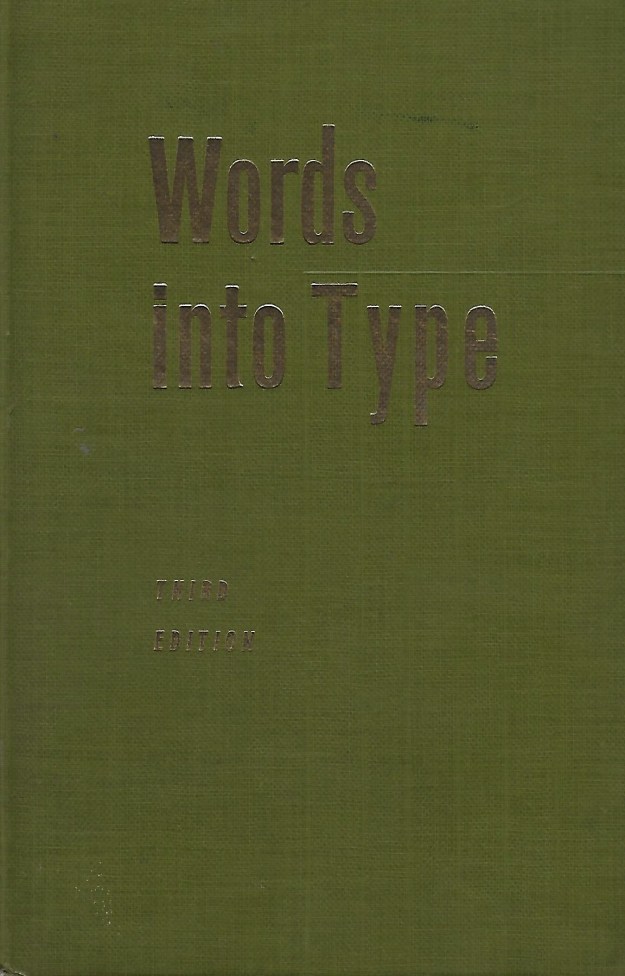
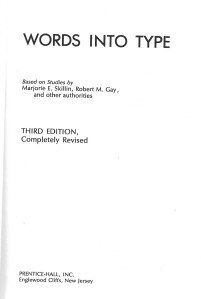
Words into Type

Third Edition, Completely Revised

by Marjorie E. Skillin and Robert M. Gay

Englewood Cliffs, NJ: Prentice-Hall, Inc., 1974


*****************************************************

This book is a must if you are a writer or care about style and grammar.

It is far superior to The Chicago Manual of Style and much easier to use.

It is superbly organized with a fabulous index which makes everything super easy to find. Say, you want to know whether or not to italicize the name of a ship, of the name of a TV series. Just look in the index under “ships” or “TV,” and you will find the page immediately.

This is an indispensable book that has never been superseded. As a writer and former copy editor. I can’t imagine being without it.

— Roger W. Smith

   January 2019


*****************************************************

Addendum:

I just looked up Words into Type on amazon.com. The book is out of print. Subsequent to publication of the edition mentioned above, which I purchased, the book seems to have been reissued in paperback.

Believe me, this is a must have book for a writer who needs a copyeditor in the form of a reference book ever reliably at hand. It is clear and comprehensive, and seems to address every sort of niggling question about capitalization, italicization, punctuation, and the like a writer might have. As I stated above, the index is superb. You can find anything you want within a matter of seconds.


Scan (2).jpg

jargon (aka mumbo jumbo)


An element of a shared symbolic system which serves as a criterion or standard for selection among the alternatives orientation which are intrinsically open in a situation may be called a value …. But from this motivational orientation aspect of the totality of action it is, in view of the role of symbolic systems, necessary to distinguish a value-orientation” aspect. This aspect concerns, not the meaning of the expected state of affairs to the actor in terms of his gratification-deprivation balance but the content of the selective standards themselves. The concept of value-orientations in this sense is thus the logical device for formulating one central aspect of the articulation of cultural traditions into the action system.

It follows from the derivation of normative orientation and the role of values in action as stated above, that all values involve what may be called a social reference …. It is inherent in an action system that action is, to use one phrase, “normatively oriented.” This follows, as was shown, from the concept of expectations and its place in action theory, especially in the “active” phase in which the actor pursues goals. Expectations then, in combination with the “double contingency” of the process of interaction as it has been called, create a crucially imperative problem of order. Two aspects of this problem of order may in turn be distinguished, order in the symbolic systems which make communication possible, and order in the mutuality of motivational orientation to the normative aspect of expectations, the ‘Hobbesian’ problem of order.

The problem of order, and thus of the nature of the integration of stable systems of social interaction, that is, of social structure, thus focuses on the integration of the motivation of actors with the normative cultural standards which integrate the action system, in our context interpersonally. These standards are, in the terms used in the preceding chapter, patterns of value-orientation, and as such are a particularly crucial part of the cultural tradition of the social system.

— Talcott Parsons, The Social System


*****************************************************


The sociologist C. Wright Mills “translated” the above passage into jargon free English, as follows:

People often share standards and expect another to stick to them. In so far as they do so, their society may be orderly.

— C. Wright Mills, The Sociological Imagination


Thus, reducing the length of the passage from 331 words (per Parsons) to 23 words (in Mills’s “translation”).


*****************************************************


The quotations/examples are included in Style: An Anti-Textbook by Richard A. Lanham.


— posted by Roger W. Smith

   December 2017

“the wide effulgence of a summer noon”; the beauty of great writing


I have begun reading Samuel Johnson’s The Lives of the Poets, a work I have been intending for some time to read.

I think reading gives me the greatest pleasure of all. Here is Johnson on the metaphysical poets:

Their attempts were always analytick; they broke every image into fragments and could no more represent by their slender conceits and laboured particularities, the prospects of nature or the scenes of life than he, who dissects a sun-beam with a prism, can exhibit the wide effulgence of a summer noon.” — “Cowley”

Like a biologist or physician examining a tissue under a microscope, I can detect great writing (and tell good from mediocre or bad); can recognize, appreciate, and delight in power and subtlety of exposition, when happily seen, from a sentence or two.

Reading gives me the greatest pleasure imaginable. The above sentence shows why Samuel Johnson is so admired and why he has few rivals as a writer of expository prose.


— Roger W. Smith

  November 2018

regarding Professor Strunk’s admonition, “Omit Needless Words.” (or, are long, complex sentences bad?)


Should long, complex sentences be considered, a priori, evidence of bad writing? Ask Samuel Johnson. Or practically any other great writer one can think of.

Sometimes the shortest sentences can be extremely powerful: “Jesus wept” (John 11:35).

But, note what Professor Brooks Landon has to say in his lecture ““Grammar and Rhetoric” (lecture 2, “Building Great Sentences: Exploring the Writer’s Craft”; The Great Courses/The Teaching Company).


*****************************************************

… unless the situation demands otherwise, sentences that convey more information are more effective than those that convey less. Sentences that anticipate and answer more questions that a reader might have are better than those that answer fewer questions. Sentences that bring ideas and images into clearer focus by adding more useful details and explanation are generally more effective than those that are less clearly focused and that offer fewer details. In practice, this means that I generally value longer sentences over shorter sentences as long as the length accomplishes some of those important goals I’ve just mentioned.

Many of us have been exposed over the years to the idea that effective writing is simple and direct, a term generally associated with Strunk and White’s legendary guidebook The Elements of Style, or we remember some of the slogans from that book, such as, “Omit needless words.” … [Stunk concluded] with this all important qualifier: “This requires not that the writer make all his sentences short, or that he avoid all detail and treat his subjects only in outline, but that he make every word tell.” … Strunk’s concern is specifically with words and phrases that do not add propositions to the sentence [e.g., “owing to the fact that” instead of “since”].”

… simple does not mean simplistic. Direct does not mean short. And, simple and direct does not mean that we should all write like Ernest Hemingway in a hurry. “Omit needless words” is great advice, but not when it gets reduced to the belief that shorter is always better, or that “needless” means any word without which the sentence can still make sense.

… I like Faulkner, as well as I like Hemingway. And, I’d like to believe that even Professor Will Strunk and certainly E. B. White would not have tried to edit Faulkner out of existence.

… Strunk and White do a great job of reminding us to avoid needless words, but they don’t begin to consider all of the ways in which more words might actually be needed. … in many cases, we need to add words to improve our writing … rather than trying to pare our writing down to some kind of telegraphic minimum.

— posted by Roger W. Smith

   July 2017


*****************************************************

Addendum:

from Wikipedia

https://en.wikipedia.org/wiki/Jesus_wept

Jesus wept (Greek: ἐδάκρυσεν ὁ Ἰησοῦς, edákrysen o Iesoús lit. “Jesus shed tears”) is a phrase famous for being the shortest verse in the King James Version of the Bible, as well as many other versions. It is not the shortest in the original languages. It is found in the Gospel of John, chapter 11, verse 35.

This verse occurs in John’s narrative of the death of Lazarus of Bethany, a follower of Jesus. Lazarus’ sisters – Mary and Martha – sent word to Jesus of their brother’s illness and impending death, but Jesus arrived four days after Lazarus died. Jesus, after talking to the grieving sisters and seeing Lazarus’ friends weeping, was deeply troubled and moved.