See my post about Samuel Johnson
“This pamphlet is published to prove what nobody will deny.”
at
“This pamphlet is published to prove what nobody will deny.”

See my post about Samuel Johnson
“This pamphlet is published to prove what nobody will deny.”
at
“This pamphlet is published to prove what nobody will deny.”
My essay “Baseball: An appréciation”
is, in my humble opinion, up there with some of the best writings done on the sport.
To anyone who accuses me of boasting, I would say: Show me a better piece.
It has not gotten much readership. I submitted it to a couple of journals for publication without success. Recently, I started to try to get it in the hands of some well known sportswriters.
I have proofread and polished it many times, and think I have perfected it. Yet today, an inspiration for a slight addition came to me in a “tactile” fashion.
*****************************************************
I was walking in a local park. A man and a boy who looked to be a teenager were engaged in a batting practice session, the coronavirus epidemic notwithstanding.
The boy could hit! There was a screen behind him. With each pitch, he coiled himself and swung, and would launch a ball into the air that seemed to get lost. I could sense the adult, who was pitching, sort of sucking his breath in in admiration. A kid in the outfield was giving chase.
The boy had a metal bat. It was so satisfying to hear the ping each time he connected.
Right then and there, I changed the following paragraph in my baseball essay, adding the words in italics:
A baseball. The ball itself. Holding one in your hand. Idly tossing it. The shininess and hardness. The stitching. The delight of boys in having a new, white, shiny, unscuffed ball. The crack of a wooden bat (or the ping of a metal one) connecting with a ball and sending a fly well past the infield.
An auditory experience — something experiential and non-verbal — led to this tweaking of my piece.
*****************************************************
Writers derive inspiration from all sorts of places: things thought about, read, conversation, experience, and minute observation.
— Roger W. Smith
March 26, 2020
“At least Emperor Nero supposedly only fiddled while Rome burned; he didn’t tell the Romans that the fire was no big deal.”
— Nicholas Kristof, The New York Times, March 12 2020
*****************************************************
Yes, we get the point. But, a flawed premise and a weak lead.
That Nero fiddled during the Great Fire of Rome is merely a legend, not reported in ancient historical sources; and these sources differ about many aspects of Nero’s tyrannical reign. Kristof’s “supposedly” is required, but weakens an already weak lead.
— Roger W. Smith
March 2020
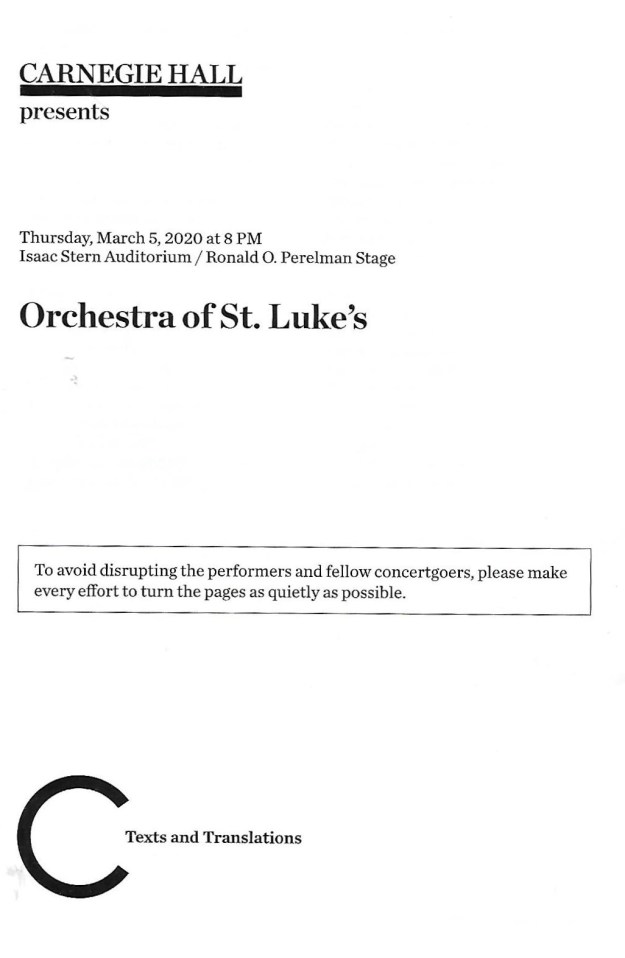

Gloria in excelsis Deo
et in terra pax hominibus bonae voluntatis.
Glory to God in the highest.
and peace to his people on earth.
— “Gloria,” Beethoven, Mass in C Major; translation, Carnegie Hall program notes; performance by Orchestra of St. Luke’s, March 5, 2010
*****************************************************
NO — “to his people on earth” is deliberately wrong.
How can one — why would one — mistranslate unambiguous words from the Latin mass? It is
Glory to God in the highest.
and peace on earth to MEN OF GOOD WILL.
Men of good will is not a “generic” phrase. It means something. To men (yes, men) of good will.
Words have a literal meaning and a connotation. Here it is the literal meaning that is in question. In my mind, these beautiful words always have evoked the thought of a community of well-meaning people, of benevolent spirits. But the anonymous translator here (read, verbal axe-wielder) has substituted the anodyne “his people on earth,” e.g., earthlings. Presumably for the sake of political correctness. This strips the phrase of its meaning.
I am offended, deeply so, that someone would change the text of a beautiful mass by Beethoven, the text of the Latin mass which has existed for over four centuries.
— posted by Roger W. Smith
March 6, 2020
“Use the active voice.”
— William Strunk Jr. and E. B. White, The Elements of Style, Third Edition
I came across the following clause in Chapter XI of The Sun Also Rises, which I am currently reading: “There were cattle grazing back in the trees.”
As opposed to “Cattle were grazing back in the trees.”
I thought about Strunk and White’s dictum to use the active voice where there is a choice between active and passive. Ernest Hemingway was known for direct, vigorous writing. Why did he choose to use a passive construction? With a writer like Hemingway, you know it was a deliberate, conscious choice.
What I would say in regard to questions (choices) like this, is that it is often a matter of ear. Sometimes the passive voice is desirable, preferable. Hemingway was conveying the idea that cattle grazing on the side of a mountain was something perceived passively, so to speak, by the narrator. The cattle were there.
*****************************************************
Let’s look at the entire passage (from The Sun Also Rises).
The bus climbed steadily up the road. The country was barren and rocks stuck up through the clay. There was no grass beside the road. Looking back we could see the country spread out below. Far back the fields were squares of green and brown on the hillsides. Making the horizon were the brown mountains. They were strangely shaped. As we climbed higher the horizon kept changing. As the bus ground slowly up the road we could see other mountains coming up in the south. Then the road came over the crest, flattened out, and went into a forest. It was a forest of cork oaks, and the sun came through the trees in patches, and there were cattle grazing in back in the trees. We went through the forest and the road came out and turned along a rise of land, and out ahead of us was a rolling green plain, with dark mountains beyond it. These were not like the brown, heat-baked mountains we had left behind. These were wooded and there were clouds coming down from them. The green plain stretched off. It was cut by the fences and the white of the road showed through the trunks of a double line of trees that crossed the plain toward the north. As we came to the edge of the rise we saw the red roofs and while houses of Burguete ahead strung out on the plain. and away off on the shoulder of the first dark mountain was the gray metal-sheathed roof of the monastery of Roncesvalles.
This is a beautiful passage and an excellent example of descriptive prose (in a novel). Sometimes less is more, as readers of Hemingway well know. I was reminded of the visual and other arts (e.g., music) of Hemingway’s time. And, for example, of the woodcut prints of Utagawa Hiroshige.

Compare the following paragraphs from Book Two, Chapter V of Theodore Dreiser’s An American Tragedy:
It was thus that, strolling west along River Street on which were a number of other kinds of factories, and then north through a few other streets that held more factories–tinware, wickwire, a big vacuum carpet cleaning plant, a rug manufacturing company, and the like–that he came finally upon a miserable slum, the like of which, small as it was, he had not seen outside of Chicago or Kansas City. He was so irritated and depressed by the poverty and social angularity and crudeness of it–all spelling but one thing, social misery, to him–that he at once retraced his steps and recrossing the Mohawk by a bridge farther west soon found himself in an area which was very different indeed–a region once more of just such homes as he had been admiring before he left for the factory. And walking still farther south, he came upon that same wide and tree-lined avenue–which he had seen before–the exterior appearance of which alone identified it as the principal residence thoroughfare of Lycurgus. It was so very broad and well-paved and lined by such an arresting company of houses. At once he was very much alive to the personnel of this street, for it came to him immediately that it must be in this street very likely that his uncle Samuel lived. The houses were nearly all of French, Italian or English design, and excellent period copies at that, although he did not know it.
Impressed by their beauty and spaciousness, however, he walked along, now looking at one and another, and wondering which, if any, of these was occupied by his uncle, and deeply impressed by the significance of so much wealth. How superior and condescending his cousin Gilbert must feel, walking out of some such place as this in the morning.
Then pausing before one which, because of trees, walks, newly-groomed if bloomless flower beds, a large garage at the rear, a large fountain to the left of the house as he faced it, in the center of which was a boy holding a swan in his arms, and to the right of the house one lone cast iron stag pursued by some cast iron dogs, he felt especially impelled to admire, and charmed by the dignity of this place, which was a modified form of old English, he now inquired of a stranger who was passing–a middle-aged man of a rather shabby working type, “Whose house is that, mister?” and the man replied: “Why, that’s Samuel Griffiths’ residence. He’s the man who owns the big collar factory over the river.”
At once Clyde straightened up, as though dashed with cold water. His uncle’s! His residence! Then that was one of his automobiles standing before the garage at the rear there. And there was another visible through the open door of the garage.
Dreiser is not painting word-pictures, It’s all basically exposition. The ‘descriptive” details serve one purpose, and one purpose only.
River Street was in the poor part of town with factories and slums. Clyde’s uncle’s residence was in the rich section. He was “charmed by the dignity of this place [his uncle’s], which was a modified form of old English.” This tells us really nothing about what the place looked like. He made an inquiry of “a stranger who was passing–a middle-aged man of a rather shabby working type.” This could describe any number of working class men; it tells us nothing about what the man looked like.
— posted by Roger W. Smith
March 2020
with thanks to my brother Pete Smith for encouraging me to read some more Hemingway; and for pointing out stylistic differences between Hemingway and Dreiser
*****************************************************
Addendum:
To be fair, it should be noted that Strunk and White also say that the active versus passive rule “does not … mean that the writer should entirely discard the passive voice, which is frequently convenient and sometimes necessary.” But the examples they give of sentences where the passive is desirable are of academic-type writing, not of narration and pithy sentences such as one would see in fiction. They state:
The habitual use of the active voice … makes for forcible writing. This is true … in narrative concerned principally with action. …
They give as an example “Dead leaves covered the ground.” and state that “[W]hen a sentence is made stronger [through use of the active voice], it usually becomes shorter. Thus, brevity is a by-product of vigor.”
*****************************************************
Addendum:
In a recent post of mine
“a red cord thing”
I wrote:
English is a marvelously fertile and flexible language, rich in nuance. New ways of saying things in non-formal speech are always being come up with.
The concluding clause was remarked upon by a reader of the post, who found it to be awkward. In response to a comment, in an exchange we had, I wrote:
I could have written something like “People are constantly coming up with new ways of saying things,” but I wanted to avoid there being a subject-actor, so the passive construction works. “New ways of saying things” is the subject of the sentence and is at the beginning, emphasizing this (new says of saying things), and “being come up with” is at the end (passive construction).
In the courtroom, Weinstein, leaning over his walker, looked downtrodden after conferring with his lawyers about the developments. Later, in the hallway, the once-powerful movie producer shrugged and stayed silent as reporters shouted questions about the jury indications.
— “Harvey Weinstein jury suggests it’s deadlocked on two counts, unanimous on others in sexual assault case,” by Shayna Jacobs, The Washington Post, February 21, 2020
*****************************************************
downtrodden
oppressed or treated badly by people in power.
EXAMPLE: Christian churches had a custom of placing metal boxes outside their doors on this day to collect cash and gifts for the downtrodden.
downcast
low in spirit, dejected
The reporter should have used downcast.
— Roger W. Smith
February 2020
In a text I bought for my German course, Basic German: A Grammar and Workbook, 2nd Edition, by Heiner Schenke, Anna Miell, and Karen Seago, pg. 7, it says:
A verb with a personal ending — e.g., Woher kommst du? Ich wohne in Frankfurt, Woher kommst du? — is called a finite verb. This is in contrast to the infinitive form of verbs.
I never knew.
In other words, a verb when used with a subject and tense — we speak, they spoke, English is spoken — is finite, determinate; there is definite action, occurrence.
But, yes, Shakespeare can write to be or not to be, but to be is timeless, so to speak. But, I was satisfied — this refers to the past and an actual point on time, whether specified or not.
*****************************************************
I love learning new things. In the category of learning “I never knew that.” Something simple that should have been obvious, but that for me represents a discovery.
When you learn it, some fundamental that increases overall understanding is now part of your mental repertoire.
— Roger W. Smith
February 2020
A reader of one of my posts wrote to me that the essays of Johnson, Addison, and Steele “are well worth reading, … but their style is clearly dated.”
I wonder.
Reading some of Samuel Johnson’s miscellaneous writings today, I was thinking to myself (as I often do) how clearly written they are and how they provide models for good writing.
Yes, there are anachronisms in usage — certainly in spelling (as well as conventions in capitalization and hyphenation) — as well as vocabulary in Johnson’s writings, and in those of Addison and Steele, whose essays provided a model for Johnson’s.
Here is an example from one of Steele’s essays:
An Author, when he first appears in the World, is very apt to believe it has nothing to think of but his Performances. With a good Share of this Vanity in my Heart, I made it my Business these three Days to listen after my own Fame; and, as I have sometimes met with Circumstances which did not displease me, I have been encountered by others which gave me much Mortification. It is incredible to think how empty I have in this time observed some Part of the Species to be, what mere Blanks they are when they first come abroad in the Morning, how utterly they are at a Stand, until they are set a going by some Paragraph in a News-Paper: Such Persons are very acceptable to a young Author, for they desire no more (in anything) but to be new, to be agreeable. If I found Consolation among such, I was as much disquieted by the Incapacity of others. These are Mortals who have a certain Curiosity without Power of Reflection, and perused my Papers like Spectators rather than Readers.
But there is so little Pleasure in Enquiries that so nearly concern our selves (it being the worst Way in the World to Fame, to be too anxious about it), that upon the whole I resolv’d for the future to go on in my ordinary Way; and without too much Fear or Hope about the Business of Reputation, to be very careful of the Design of my Actions, but very negligent of the Consequences of them.
— Richard Steele, The Spectator No. 4, Monday, March 5, 1711
This seems to be a specimen of clear, straightforward, and plain good writing. Does such writing go out of fashion?
*****************************************************
In a different vein — but also, to provide a specimen from Johnson — here is a brief passage from a book review by Samuel Johnson from my reading today:
He [Joseph Warton] mentions, with great regard, [Alexander] Pope’s ode on solitude, written when he was but twelve years old, but omits to mention the poem on silence, composed, I think, as early, with much greater elegance of diction, music of numbers, extent of observation, and force of thought. [italics added]
— Samuel Johnson, review of Joseph Warton, An Essay on the Writings and Genius of Pope, Literary Magazine (1756)
The concluding sequence of four phrases is an example of why Johnson’s writings merit study on stylistic grounds. On account — in this example — of excellence of phrasing, parallelism, and how pleasing to the ear, how euphonious, such wording is.
One phrase follows another, forming an integrated whole. A thought or concept clearly and forcefully expressed. The words strike home.
The mind yearns for completion. In Johnson, this is usually achieved.
It is very much like a cluster of notes in music, when notes follow and build on those before, when they not only fit together, cohere, but provide a sense of resolution.
— Roger W. Smith
February 9, 2020
Re:
“A Deal That Has Two Elections, Rather Than Mideast Peace, as Its Focus; The Israeli-Palestinian peace plan unveiled by President Trump and Prime Minister Benjamin Netanyahu sounds more like a road map for their own futures than for the Middle East.”
by David E. Sanger
The New York Times
January 28, 2020
*****************************************************
My English teacher, Mr. Tighe, would be proud of a paper as well written as this. It exhibits masterful observance of the three core principles of expository writing: unity, coherence, and emphasis (meaning that the key points emerge clearly).
The details and quotes are stitched together with consummate skill. The organization and logic are impeccable, and the thrust of the piece is admirably clear.
I once wrote a reference book article on the British historian A. J. P. Taylor. It was approximately 2,600 words long. My former therapist, Dr. Ralph Colp, Jr., who was always eager to read my writings (he was a writer himself), said that there was not “a single wasted word” in the article. Without comparing myself to Mr. Sanger, I would say that the same is true of his piece.
This may seem like a routine job of reporting. It was written on the spot–at the moment. It could serve as a model for students of journalism and in English classes as well.
— Roger W. Smith
January 2020
THE TELLING EXAMPLE
The kind partiality with which every man looks upon his own fraternity, is generally discovered in his acts of munificence. The merchant seldom founds hospitals for the soldier; nor the sailor endow colleges for the student. [italics added] Every man has had most opportunities of knowing the calamities incident to his own course of life: And who can blame him for pitying those miseries which he has most observed?
It is with the same kind of propension that I have always rejoiced to see the theatres made instrumental to the relief of literature in distress; and though I would not willingly oppose any act of charity, I cannot but confess a higher degree of pleasure, in contributing to the support of those, who have themselves contributed to the advancement of learning; and therefore take, with uncommon satisfaction, this opportunity of informing the town, that next Tuesday will be acted, at Covent Garden, The Way of the World, for the benefit of an unfortunate bookseller [James Crokatt]; a person, who, in his happier state, was little guilty of refusing his assistance to men of letters; whose purse often relieved them, and whose fertility of schemes often supplied them with opportunities of relieving themselves.
PARALLELISM
Many of the most voluminous and important works, which the industry of learning has lately produced, were projected by his [Crokatt’s] invention, undertaken by his persuasion, and encouraged by his liberality. The time is now come when he calls, in his turn, for assistance; and it is surely the duty of the publick to reward, by uncommon generosity, the benefits which he has conferred upon them, without the usual advantage to himself. (italics added) — Samuel Johnson, Letter to the Daily Advertiser Concerning James Crokatt (1751), IN Johnson on Demand: Reviews, Prefaces, and Ghost-Writings, edited by O M Brack, Jr., and Robert DeMaria, Jr. (The Yale Edition of the Works of Samuel Johnson, Volume XX; Yale University Press, 2019), pg. 221
This letter was written by on behalf of the London book trade entrepreneur James Crokatt, who having experienced business and financial difficulties, was in debtors’ prison.
*****************************************************
From immersion in the works of a writer of Johnson’s stature, I would be inclined to say that:
Anecdotes from the early chapters of Boswell’s Life of Johnson show that Johnson at a very young age was what we would today call a gifted child and that he was intellectually precocious.
It is also apparent from Johnson’s own accounts (and those of schoolmates) that his grammar school instruction was very rigorous in the area of rhetoric, including instruction in Latin. (I believe that his fluency in Latin along with his mastery of the king’s English contributed to, and in fact resulted in, his knowledge of and proficiency in rhetoric and mastery of the rules of exposition and grammar, whereby the “operating principles,” so to speak, of verbal expression were ingrained in him — at his command.) *
Ergo, Johnson wrote as well as he did because he was a born writer and also because he worked so hard at achieving mastery.
* The following quote is apropos. I can relate it to my own experience of foreign language study.
“Wer fremde Sprachen nicht kennt, weiß nichts von seiner eigenen.” (He who is ignorant of foreign languages, knows not his own.)
— Johann Wolfgang von Goethe, Maximen und Reflexionen (1833)
— Roger W. Smith
January 2020
 Roger's rhetoric